Crews, gangs, collectives: graffiti and the need to belong
My 2020 essay on graffiti: why crews form, how the need to belong pushed style forward, and how the system finally swallowed street art and made it pay.
An essay I wrote in June 2020 for the Design Theory II course at Vakalo College, just before I finished my graphic design studies. I keep its full title as it was: "Crews, gangs, collectives: the question of 'belonging' and the role of collectives in the evolution of graffiti and street art". I publish it here almost as I handed it in, because walls are where I started. Translated from the Greek original.
From the wall
From the start of my "career" as a graffiti writer – street artist – bomber – troublemaker, or simply a borderline unruly kid who didn't care about his fellow citizens' toil and property, I believed in a world where everything should be for everyone. I believed that nobody was responsible or capable enough to set their own rules over my own field of thought, action and reaction. Prohibition, especially at a young age, showed itself to me quite often, both from the core of the family and from my wider social circles. School, the swimming pool, even the empty lot where we played as kids, each set their own separate, inviolable rules, and if you didn't keep them you would certainly face the consequences.
From the start of our "career" as human beings, we often feel trapped and unfree inside the social groups we join, whether they are old and sclerotic, like the church, or young, like the empty lot, groups that are nevertheless bound to some form of "law" (as defined by the wider social structure of the time) in the way they work. In short, graffiti, from personal experience, was both the means and the occasion to detox from the "musts" imposed on me, to feel removed from massification and to let out whatever negative feelings had built up in me until then.
In this essay, written for Design Theory II, we will look at street art and graffiti (a little) more freely. We will deal with the reactive nature of this kind of art against the capitalist and advertising-driven shaping of the urban landscape, with the question of "belonging", and with the role of collectives in its evolution.
Subcultures
The first thing explored is the existence, through creation, of various kinds of subculture, as found in different countries and societies. The term subculture is first attributed to Alfred McClung Lee (1945). It was Milton Gordon, however, who gave the first definition of subculture, two years after McClung Lee: "[A subculture is] a subdivision of a national culture, composed of a combination of factorable social situations such as class status, ethnic background, regional and rural or urban residence, and religious affiliation, but forming in their combination a functioning unity which has an integrated impact on the participating individual." Moreover, Gordon argues, we can make out "relatively closed and cohesive systems of social organisation, which we analysed [until now] separately, with the more conventional tools of 'class' and 'ethnic group'".
As for Albert K. Cohen, "the concept of culture refers to the knowledge, beliefs, values, codes, tastes and prejudices that are traditional in social groups and that are acquired by participation in such groups." But "the concept of culture is not confined to the distinctive ways of life of such large-scale national and tribal societies. Every society is internally differentiated into numerous sub-groups, each with ways of thinking and doing that are in some respects peculiarly its own, that one can acquire only by participating in these sub-groups and that one can scarcely help acquiring if he is a full-fledged participant. These cultures within cultures are subcultures."
The need to belong
Turning next to the question of belonging: the human being is a social being, and this has been on record since Aristotle): "Hence it is evident that the state is a creation of nature, and that man is by nature a political animal. And he who by nature and not by mere accident is without a state, is either a bad man or above humanity." Yet people, then and now, often tend to set themselves apart, to want to stand out, to carve out their own road and their own path, to escape the behaviour of the crowd and to be recognised as unique. Uniqueness is the natural reaction to the pull of sociality. Graffiti is the reaction that comes, just as naturally, to mass advertising and to the imposition of desires and feelings in modern capitalist societies.
According to the social psychologist Roy Baumeister: "The hypothesis that people are motivated to form and maintain interpersonal bonds is not new, of course. John Donne (1975) has been widely quoted for his line 'No [person] is an island.' Maslow (1968) ranked 'love and belongingness needs' in the middle of his motivational hierarchy; that is, belongingness needs do not emerge until food, safety and other basic needs are satisfied, but they take precedence over esteem and self-actualisation. Bowlby's attachment theory (e.g. 1969, 1973) also posited a need to form and maintain relationships. The need to belong is innate and almost universal among people. In contrast to the Freudian view, which saw sexuality and aggression as the main psychological drives, and to most behaviourist views, which saw every newborn as a tabula rasa (blank slate), our view presents people as naturally driven to form and maintain relationships. The need to belong should therefore be found to some degree in all humans in all cultures, although one would expect individual differences, as well as cultural and individual variations in how people express and satisfy it. It should prove difficult, if not impossible, for culture to eliminate the need to belong. This innate trait probably has an evolutionary basis: the desire to form and maintain social bonds appears to have survival and reproductive benefits."
Crews
It is also an outward expression of the wish, mostly of young people, to radically change their destination against the "musts" and the established, socially accepted rules. And that is how crews were born. I'm joking, of course, since there are other factors that either won't be analysed here or that I don't know. But, speaking mainly from personal experience, as a young man I too wanted to stand out, both as a person and from the crowd, and doing that on your own is not the easiest thing. You need allies, and they need you. Allies are needed only in hard times, not easy ones: they want you and you want them only to share whatever punishment comes, not prosperity and recognition. So you are accomplices. You make your pieces together, your offences and your violations.
So here is the trap of uniqueness. You think you are escaping the trap of the masses, but you join the next, deeper trap, I say it again, where your ego grows, narcissism blooms and rivalry increases. Crews compete with one another while their internal feuds flare up, always looking for and finding a reason. Very few manage to get out and see things differently. If you get out, you will certainly have gained a lot. It is important to cross to one side, then the other, then another. We ought to walk between normality and uniqueness, legality and transgression, all our lives, so that we can tell the rights and wrongs of each. Only then will we escape any fixed stance and dogma, and be able to lift up the mind and the spirit.
The individual's rebellious mood, the wish to stand out and be different, creates the need to gather with like-minded people, accomplices. The message must get out at all costs, but the recipient is unknown. There is no specific address, so the only way is to make it public. And so the only available public space is the walls of the big cities. The crews' need to communicate shaped graffiti decisively over the years, as it spread at a rapid pace and covered cities from end to end, in the search for members and recognition.
Writing in public
According to Avramidis, "public (in)scription is neither modern nor original. The history of public writing is as old as the history of humankind. From the caves, with the primeval depictions of people and animals, later in the ancient city, with writing on buildings, up to today's modern metropolis, with graffiti, there are traces that prove the innate human tendency to intervene in one's surroundings, sometimes to appropriate them, sometimes to personalise them or even to mark their limits. People have always felt the need to express themselves and leave marks of their existence. Things began to get more complicated when people started forming early civilisations, because these traces, from marks of individual existence, began to express cultural characteristics and to carry specific information. With the birth of societies, this information, representational, coded or not, or as language, carried messages of wider interest, because it 'spoke' about something: it had suddenly become a tool of communication."
The term graffiti includes sub-terms, categories. It is not one absolute thing: graffiti divides into the kinds below. According to Susan Phillips, two clearly different categories must be noted for the term to be better understood: "popular graffiti" and "community-based graffiti", which "differ both in content and in intended audience". As Avramidis goes on to describe, "it is important to note that although these types of graffiti differ in their definition, both share the same arena: public space. 'Popular graffiti', the graffiti of everyday people, is defined by Phillips as the everyday things: witty comments, phallic symbols, jokes, declarations of love or hate and the countless 'so-and-so was here'. The 'my name is so-and-so and I exist', this advertisement of existence through the name, is a defining element, if not the only reason for being, of the graffiti that Jean Baudrillard came across on his trip to New York. Of course, much of it is viewed with suspicion. Football slogans, for example, are seen by most city dwellers as aesthetic noise or a meaningless reaction. The fan writes a slogan against the rival team while making his presence felt in public space. But 'my name is so-and-so and I support such-and-such team' or 'so-and-so was here', typical of writers, is of capital importance to urban imagery and slogan writing, as are obscenities of a sexual nature.
These are largely seen as the language of the oppressed and, as such, have a natural affinity with opposition, protest and refusal. Herbert Marcuse considers the usual obscenity and the supposed political force of the slogan ineffective, adding that 'the standardised obscenity is a repressive desublimation: easy satisfaction of aggressiveness'. He believes that by debasing sexuality in this way, the radical seems to punish himself for his lack of power, so his language loses the political effect it wants. This kind of graffiti is usually written in an international language, so that everyone can understand it and join in its 'humour' or reply in kind. Everyone, more or less, comes across this kind of graffiti unexpectedly in daily life. Phillips goes on to present the second category, which probably fits the stereotypical image of the medium better: 'community-based graffiti', made by and for communities of people with shared interests. Within it she identifies three subcategories: political, gang and hip hop graffiti."
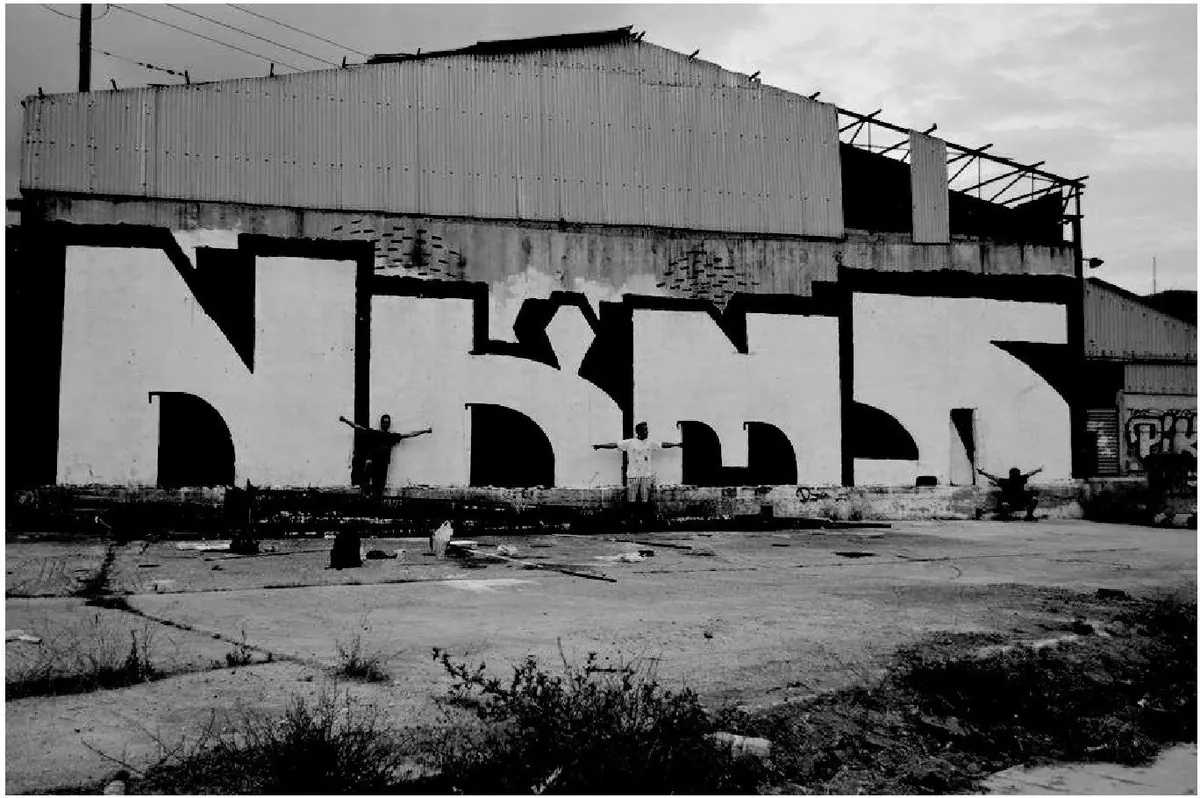
The inner need to belong shaped graffiti. Through the rivalry and conflict between the crews and collectives that coexisted in the same place, a healthy visual competition was born. Each crew tried to make the best graffiti in the neighbourhood, the city or the country, they all competed with each other, and so style evolved. Each crew wanted to see its name travel and be printed further afield, either by painting trains or by travelling the country or the continent to leave its mark, and so did the other crews. And so graffiti spread.
When the system buys it
After 1980 the tide turns. Demonstrations achieve nothing. Clashes wear you out. The system always acts with instant efficiency. Since we couldn't beat it, we become part of the enemy. After 30 we have to pay the bills ourselves. How we ended up workaholics, yuppies, social role models, I have no idea. […] Our ideals became market products. What was under[ground] for us is now pop. […] Now we are all part of the Reformation and the Counter-Reformation. […] The end of history, outdated cities, battered institutions, half the environment degraded, a climate gone mad… The peace we didn't find outside we look for inside. The counterculture went the way new ideas always go: the system first mocks them, then fights them and finally adopts what everyone is thinking. Inside and outside no longer differ at all. Everything is part of the system. (Juan Carlos Kreimer, Counterculture)
However much the social groups that stood against the central structure of society reacted, the system was and is always there to cover over, swallow, absorb and mutate every opposing voice, and in the end to reap it, commercialise it and profit from it. Illegal graffiti became legal street art and filled the city's public and private spaces with paid works that covered the illegal ones underneath.
The former illegal artists, who held the techniques and the know-how from years of illegal activity, gradually decided to become part of this "new" culture. At first they may have met it with mistrust, even fear, since they weren't used to keeping in step with the law, and their main fear was losing the authenticity they had until then. There is always the matter of making a living, too, since to live you have to be fed, and to be fed you have to eat. So more and more artists flocked, one after another, to the street art movement, taking on paid work. The love people began to feel for them was another huge incentive, that of acceptance and popularity.
The song by Gelos with Agnostoi Gnostoi and Skoteini Plevra went down in the history of Greek graffiti, and beyond, and of bombing in particular:
Τόσα χρόνια δίνουν χρώμα
σ’ όποια πόλη ίδια βρώμα,
όπως κι αν το πεις, είναι τέχνη, δεν αλλάζει φόρμα!
ό,τι είναι παράνομο διαφέρει, το φοβούνται,
βανδαλισμός στην πόλη μας, όταν αυτοί κοιμούνται!
(Gelos, beat DJ Land Roland, scratches Kebzer. Roughly: all these years they give colour to every city with the same filth; call it what you like, it is art, the form doesn't change; whatever is illegal is different, they fear it; vandalism in our city while they sleep.)
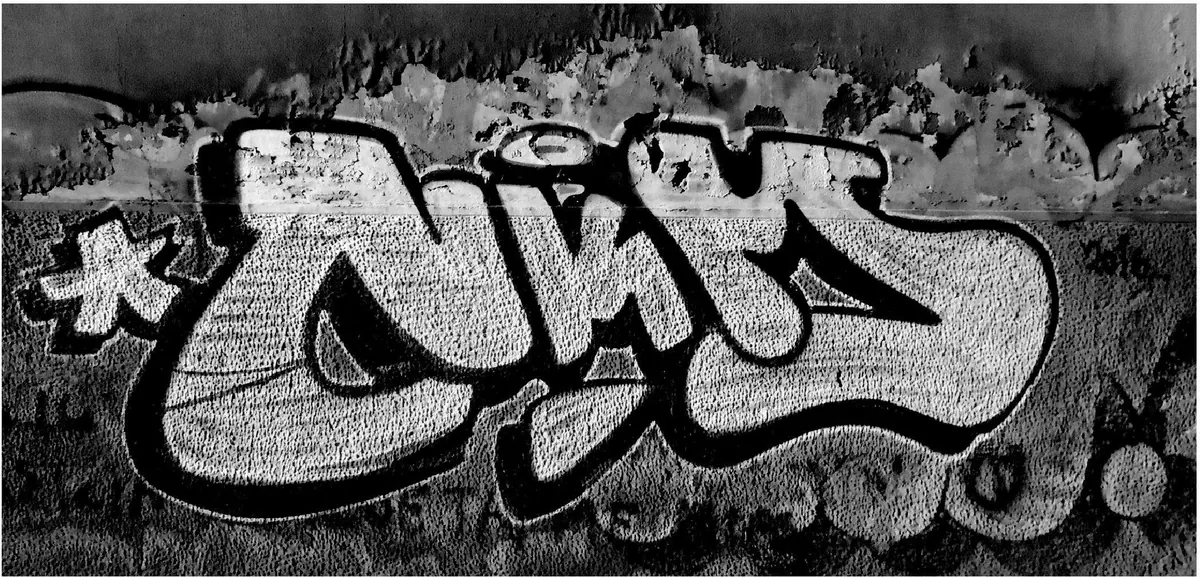
So, having helped graffiti evolve, little by little, and because of its commercialisation, the crews disappeared. Each artist who was part of a crew became a private individual, because money is hard to share.
The system managed to break up what it fears, as it always does.
Aggelos Kourtidis, June 2020, Nakama Headquarters.
Sources
- Ioannis N. Kolovos, Youth subcultures and the formation of social identity: The case of punks in Athens, 1979-2013, doctoral thesis, University of Thessaly, Department of History, Archaeology and Social Anthropology, 2013 (in Greek).
- W. D. Ross (ed.), Aristotelis Politica, Clarendon Press, Oxford 1957, reprinted 1964.
- R. F. Baumeister and M. R. Leary, The need to belong: Desire for interpersonal attachments as a fundamental human motivation, Psychological Bulletin, 117(3), 497-529, 1995.
- Konstantinos Avramidis, Graffiti, subculture: The meaning of space on the road to fame, undergraduate thesis, National Technical University of Athens, 2006 (in Greek).
- Susan A. Phillips, Wallbangin’: Graffiti and Gangs in L.A., University of Chicago Press, Chicago 1999.
- Juan Carlos Kreimer, Counterculture: The "bad" kids, Greek edition, Gnosi, Athens 2007, p. 187.
- Gelos, lyrics and vocals, beat DJ Land Roland, scratches Kebzer, on YouTube.