GRAN Caffè ItalianoLogo Design Proposal
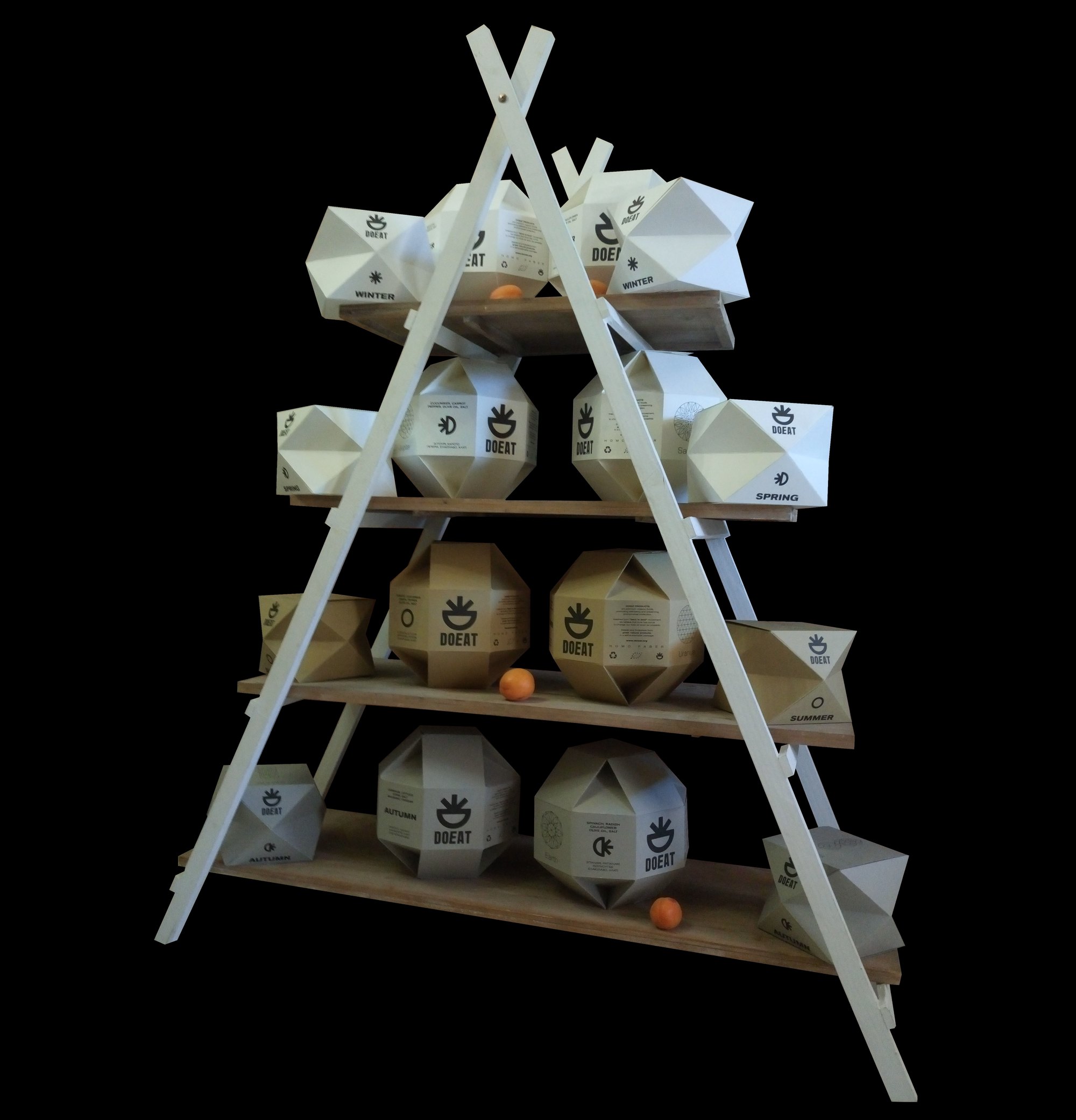
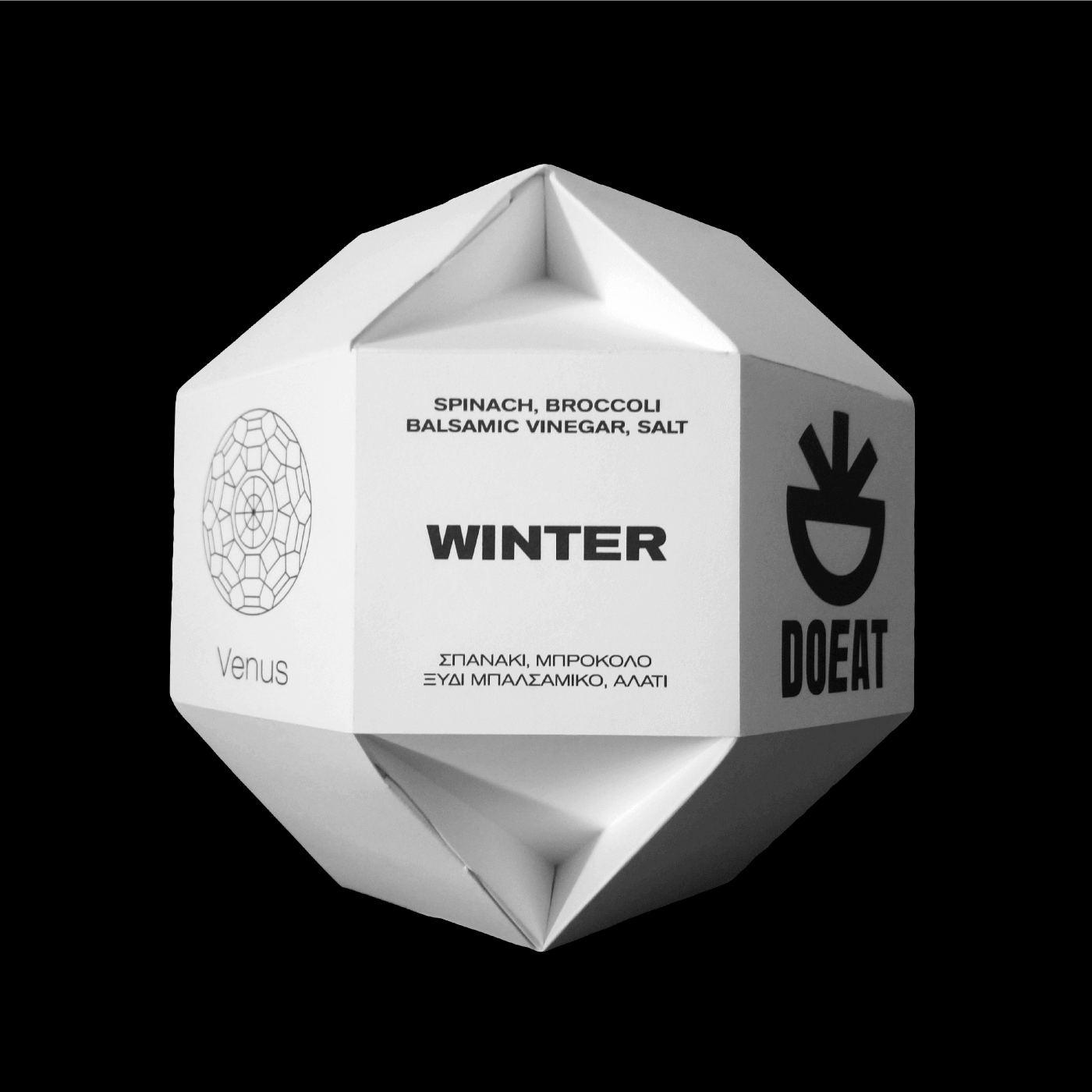
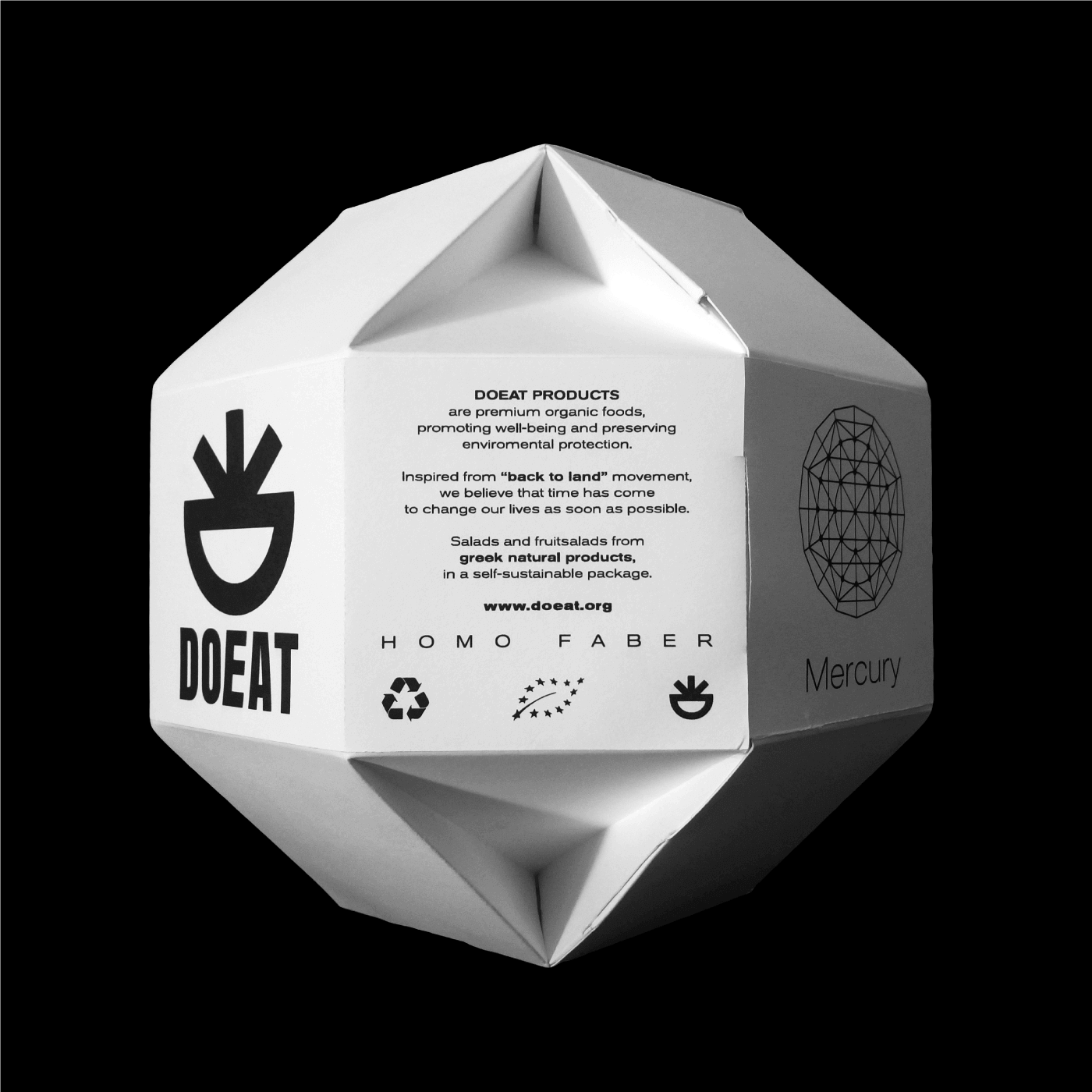
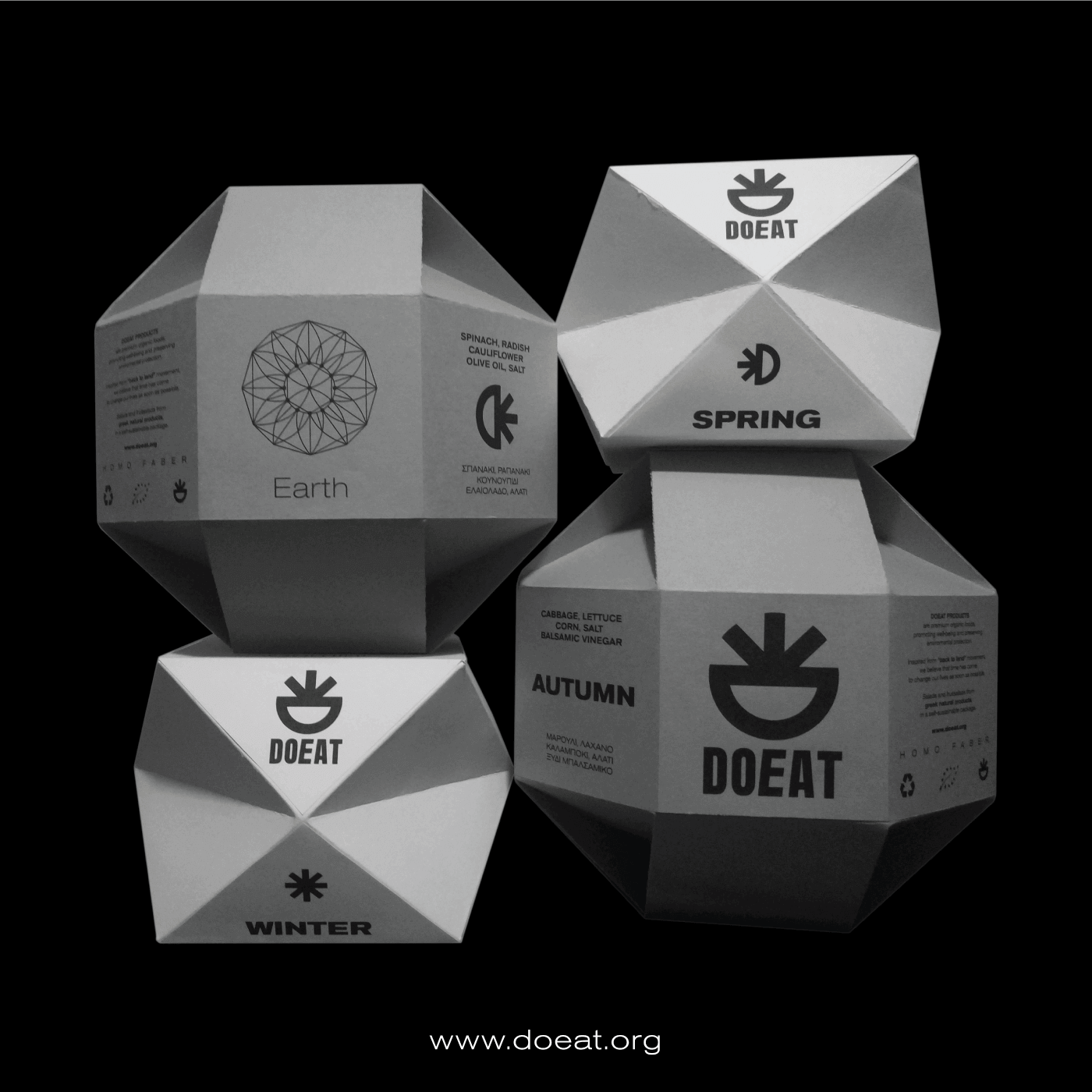
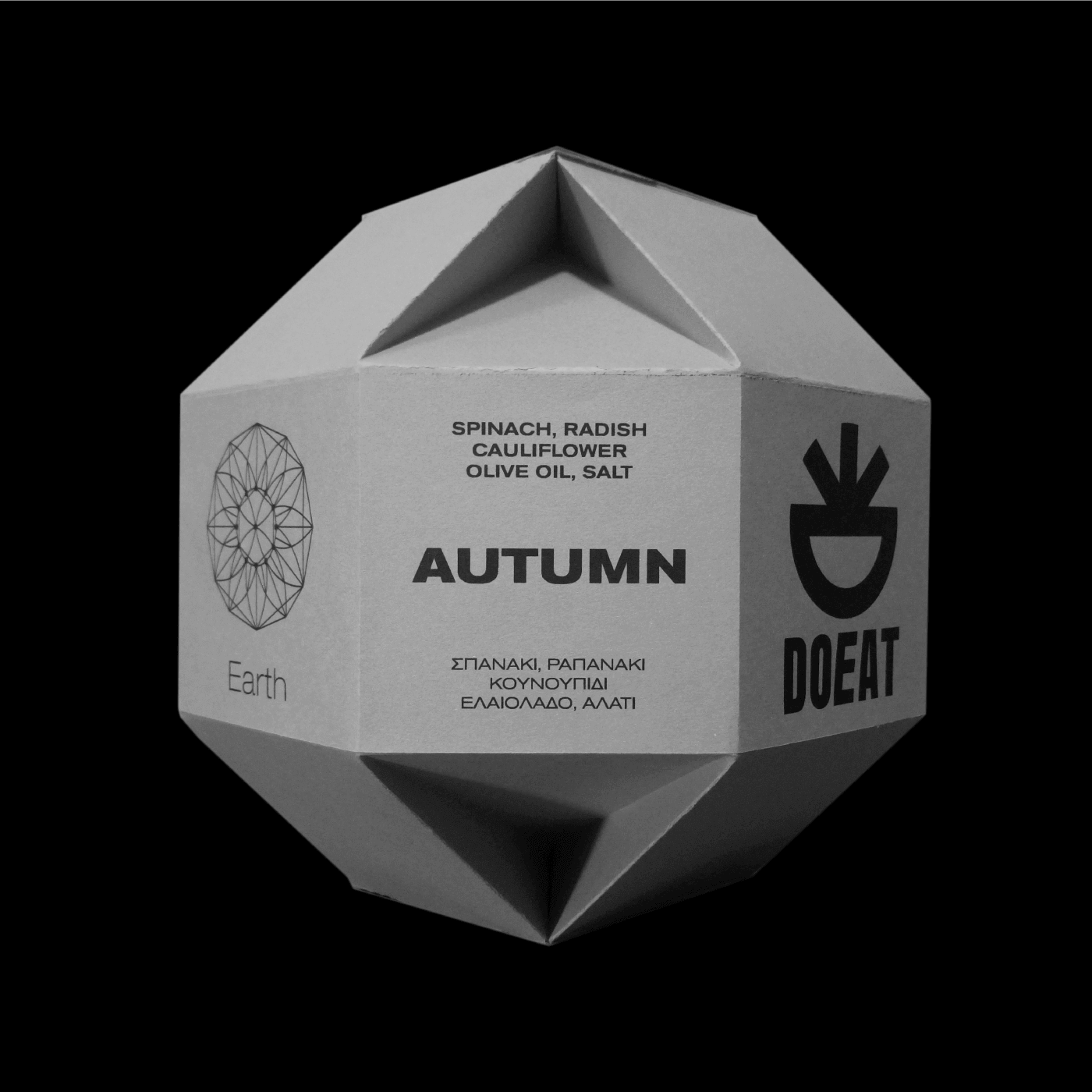
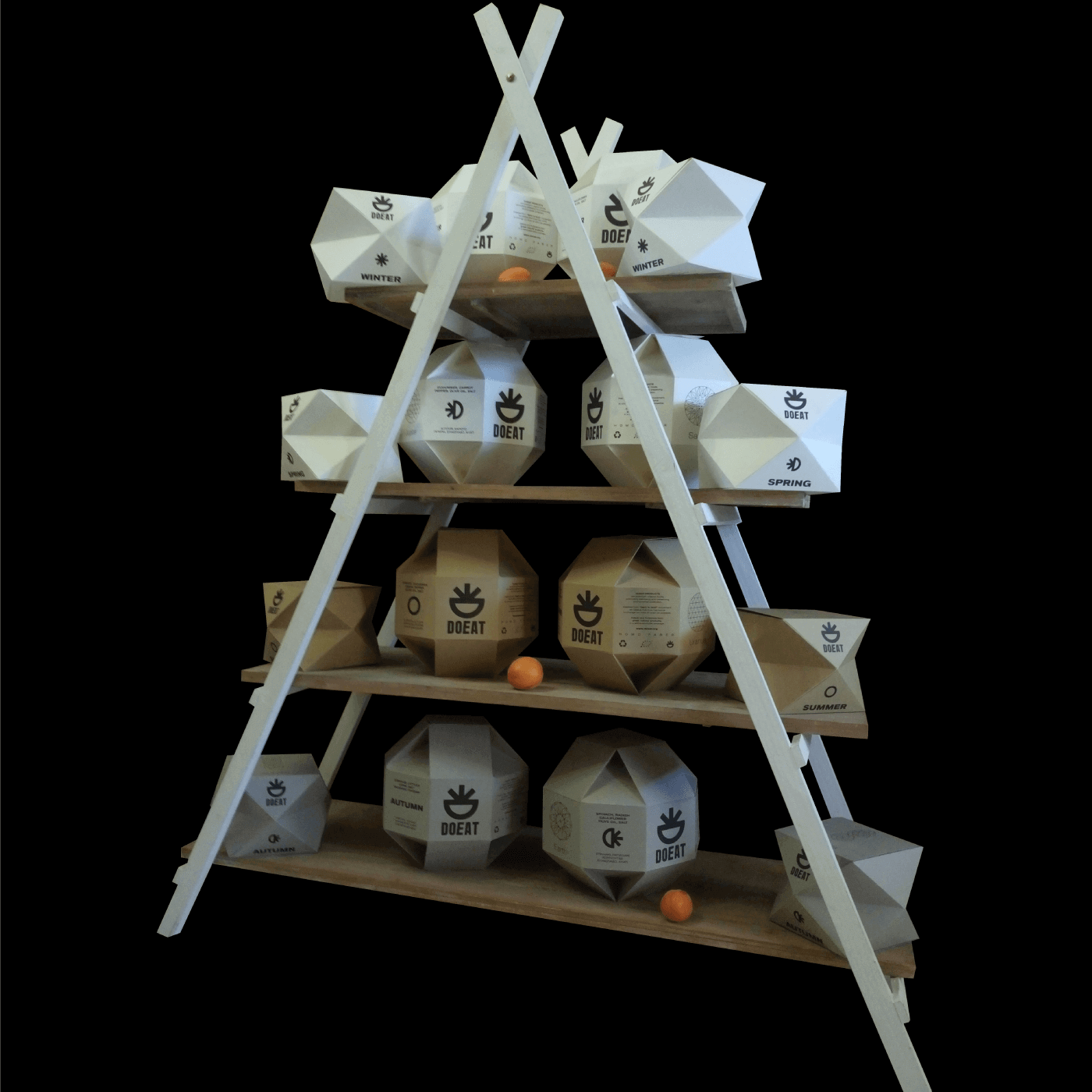
My graduation project at Vakalo School (2019-2020): the name, logo, packaging, stand, website and posters for DOEAT, an imaginary company selling salads and fruit salads made from whole Greek vegetables and fruit. Customers cut them up themselves, the package becomes a bowl and a plate, and after the meal it wraps the leftovers for composting. Four seasons give four marks, and joining them gives the logo. The polygonal boxes and the stand draw on the domes of the Whole Earth Catalog and the Back to the Land movement, while the posters borrow slogans from Fridays for Future. Below you will also find the whole research book. Homo Faber, not Homo Consumericus.
This is my graduation project at Vakalo College: the name, logo, packaging, stand, website and the research book, all done by me. If you want packaging or an identity with real thinking behind it, get in touch.
Images (11)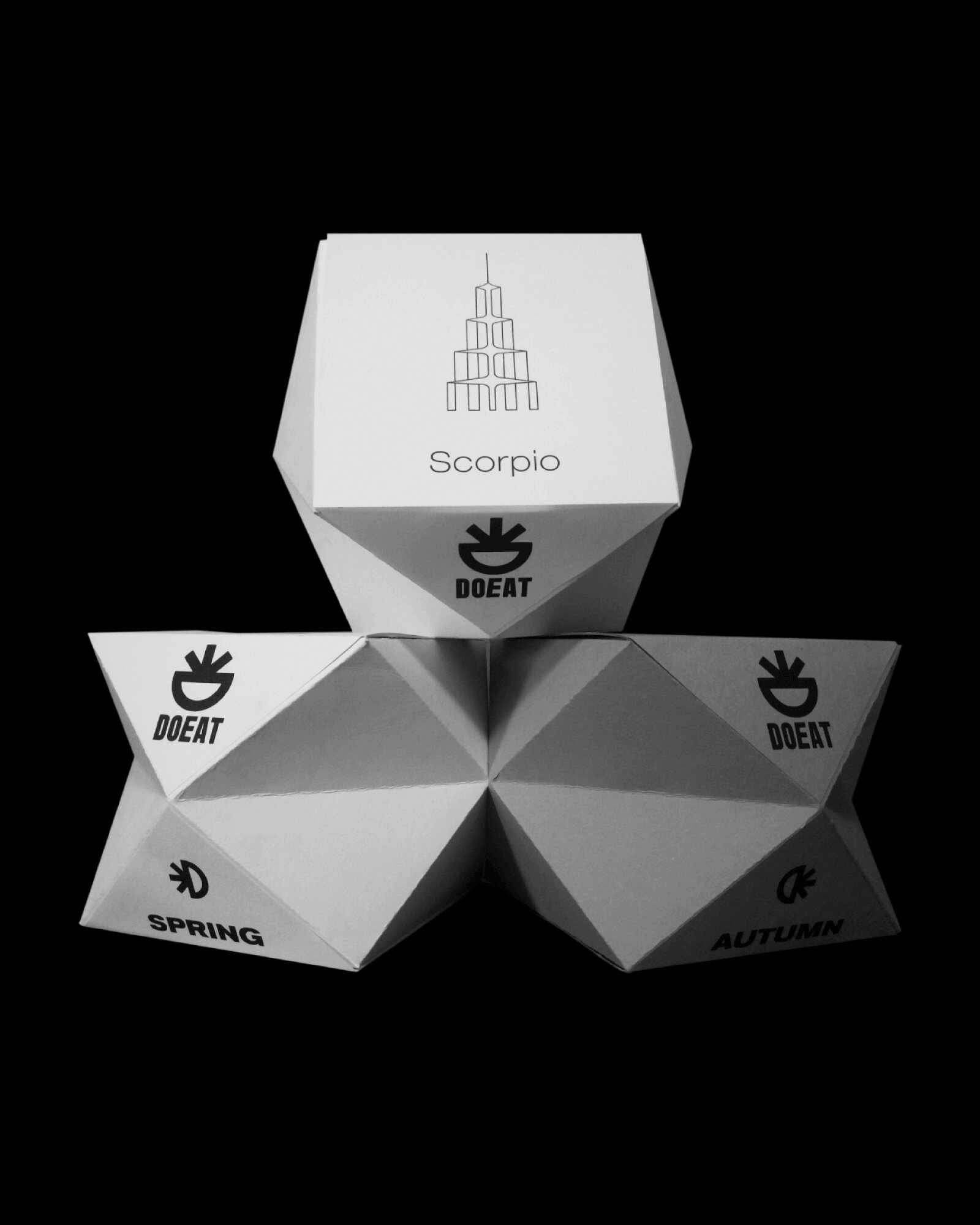
The full text of the book I wrote for DOEAT in 2020, from the first idea and the research to the logo, the packaging and the epilogue. Translated from the Greek original.
With the end of this project,
comes the end of a cycle.
For some this cycle ran its normal length,
for others it went into extra time,
while for quite a few it was postponed for good.
I belong to the second group,
so I can express some satisfaction and relief,
as a wish and a goal have been fulfilled.
I was not alone on this road,
and I felt that very strongly,
so I thank the people who walked with me
and whom I held on to (they know very well who they are).
A big thank you to the Vakalo family,
as a whole and to each one separately,
the management, teachers, secretariat and all the other staff,
who made this experience as pleasant as it could be.
Special thanks to the teachers
who supported the smooth completion of this project.
It was overwhelming how much
the way you think and live can change
after three years of study
at Vakalo College.
the end.
let’s start.
Everything starts somewhere. The source of inspiration varies, because each time it depends on different circumstances. The idea came up last summer (2019), after an interesting conversation with a friend, a fruit and vegetable grower by profession, who said he wished to export his produce abroad in the near future. He was thinking of doing it wholesale, saying that “the profit will be double” what he makes here, trading with the local market. This was the starting point for a conversation about the hypothetical, at least for now, creation of a new company whose business would be to launch two main categories of food products that add value to the original wholesale and retail price of fruit and vegetables. One category would be salads and the other fruit salads. The consumer would receive organic vegetables and fruit and, at the same time, would be made aware of a small-scale transition, from homo consumericus to homo faber. This happens because they will be asked to make their own salad. The fruit and vegetables will be placed whole inside each package, and the package will become both a preparation bowl and a plate. The buyer, opening the package, will peel and cut each fruit and vegetable into smaller pieces, mix the ingredients, and then the salad will be ready to eat. By working with the company, the Greek grower will be able to move beyond the local market and secure more income.
The company would potentially trade salads and fruit salads without animal products, with fruit and vegetables as the main ingredients. These would be whole inside the packages and eaten raw, without being cooked or processed in any way other than peeling and, of course, cutting.
The company has three main goals:
Since the crisis of 2009, the earnings of Greek business owners and employees have fallen, something that is unlikely to change in the coming years. A short while ago, just as things were improving somewhat, the coronavirus pandemic broke out, forcing large and small businesses to shut down in many countries of the world (Greece included).
As a result, young people starting their careers are the ones facing the hardest problems. Either they keep working in the Greece of the crisis and of the “post-coronavirus” era, or they are forced to emigrate to countries abroad that offer more benefits. Some keep working here, taking advantage of whatever opportunities still exist. Mediterranean countries have one advantage over the northern ones: their temperate climate, in which vegetables and fruit thrive, both essential for proper nutrition and health.
People, homo consumericus, are starting to seek a change in their habits. Because of the unhealthy and toxic life they lead, they are trying to change their everyday routine. This feeling translates into various movements and concerns a large part of the population. In addition, the protection of the environment, ecological awareness and recycling are more topical than ever.
This project tries to cover, through design and to a satisfactory level, the conceptual substance of the company described in the foreword, by creating its whole visual identity: the naming, the specially designed marks for the 4 seasons, the logo, the packages and their labels, the brand’s online presence (website, instagram profile), and the printed and digital promotional material.
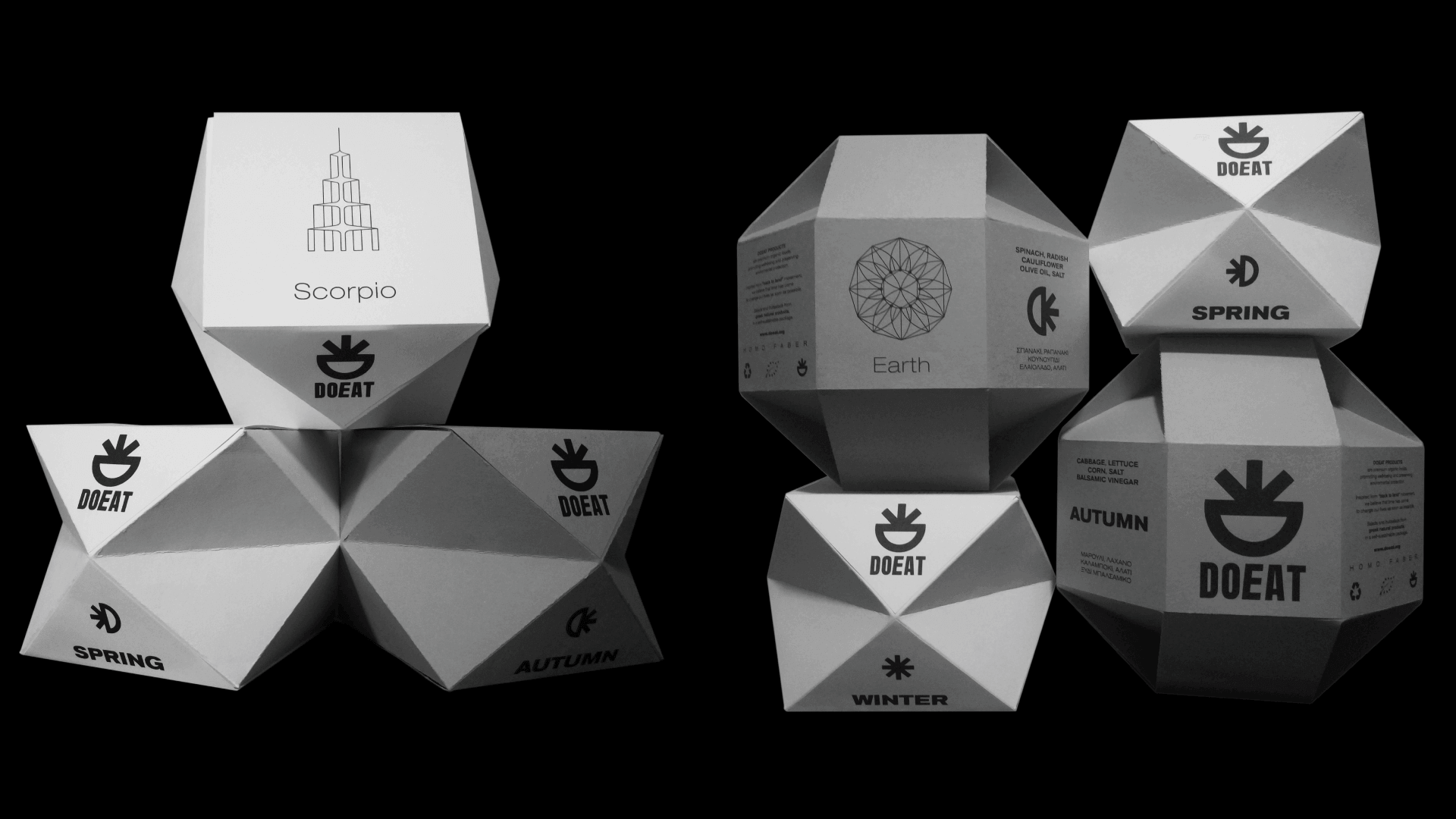
The main subject is the salads and their packaging. Two package templates will be created (one for salad and one for fruit salad), each holding its ingredients whole. The package will also become a preparation bowl and a plate. Inside will be the main ingredients (vegetables, fruit) and the extras (salt, oregano, oil). The packaging materials are recyclable and, once the contents are eaten, they are composted together with the leftovers (peels, scraps). The packages will also be divided into 4 subcategories based on the 4 seasons (winter, spring, summer, autumn), which secures the organic value of the vegetables and fruit. Each season will be split into 2 subcategories, one for salads and one for fruit salads.
The primary purpose of the project is to design a commercially successful product range that stands out on the shelf and draws the consumer in. The package, regardless of its contents, gives the first impression and is the starting point for buying and owning a consumer product.
Another goal of the design is to respect the conceptual rules and principles that govern this company, and any other company that commissions an individual or a team working in the graphic arts to bring its original idea to life and make it stand out.
An equally important priority is to create a strong and timeless brand, with its logo as the main ingredient, one that is deeply imprinted on the mind of the consumer and the viewer, representing practical, theoretical and visual axes at the same time, without becoming wordy but staying concise, clear and strong.
The company’s target group is people who want to change their habits radically, or to detox from time to time by following a plant-based diet. Also people who are aware of the pointless consumption of meat and meat products, and of the terrible conditions under which it is produced (Vegan).
It is also aimed at people who want, try and push for changes that will help protect the environment, and who are willing to replace their habits so far, if they have not done so already (Reduce, Reuse, Recycle). Citizens of Mediterranean countries are quite unlikely to become buyers of these products. The main reason is that the salads cost more than buying vegetables at retail. We are mainly targeting countries of Northern Europe, the Scandinavian countries, countries with no local production because of their climate. People in these countries are also more aware of and familiar with recycling and healthy eating, and they earn more, so there the products are affordable. Finally, the whole process involved (opening the package, cutting the ingredients, making the salad) appeals mainly to a young audience, or to a more conscious one. No specific age group has been defined.
The theoretical research will broadly cover the following topics, with History, Psychology and the socio-political dimension as its main pillars. In brief:
D.I.Y (Do It Yourself) / Homo consumericus / Homo Faber / The Science of Consumerism / Consumer Psychology / Creator Psychology / The joy of creating / Criteria of Consumerism / Vegan and Vegetarian / Veganism / The history of the Vegan movement / Reduce / Reuse / Recycle / Climate Change / Environmental Protection / Greta Thunberg / Bio-friendly / Environmentally friendly / Research on the products Greece produces and the countries they are exported to (statistics) / Research on the season in which each vegetable and fruit thrives in the country / Research on salads made with seasonal ingredients and no animal foods / Research on recyclable, environmentally friendly materials / Market research on ready-made salads / Pricing / Nutritional value / Specialised research on all of the above in the target countries for the products.
The visual research will complement and reinforce every category researched in theory, aiming to give it evidence and proof.
These sections of the official website of the European Union present the causes and consequences of climate change, gathered together and accurately. Human activities play an important part in creating and sustaining the greenhouse effect. Fuels (coal, oil, natural gas), deforestation (carbon), the growth of livestock farming (methane from digestion), nitrogen fertilisers and fluorinated gases are the causes of rising gas emissions. Carbon is responsible for 63% of global warming, methane for 19% and nitrous oxide for 6%. Today, while the average temperature of the Earth has risen by 0.85ºC compared with the pre-industrial era, the international community is trying to avoid an increase of 2ºC, a temperature that raises the risk of catastrophic changes.1
Climate change affects the planet as a whole. Melting ice and rising sea levels, extreme weather and shifting rainfall are the most serious consequences of the greenhouse effect. They bring more heatwaves, floods, fires and droughts, water shortages in some areas and heavy rainfall in others, and in general an unstable climate that affects the fauna and flora of the planet. It obviously affects people too, both socially and economically. Agriculture, forestry, energy and tourism are among the sectors hit hardest by the consequences of climate change.2
This Kathimerini article refers to the global (mainly student) mobilisation called Climate Strike, which took place on 15 March 2019. In Athens the main slogan was “The planet you are destroying is the world we inherit”. Rallies and marches were held in many countries and capitals around the world, with large turnout. Wellington in New Zealand, Paris in France, Sydney in Australia, Bangkok in Thailand and Hong Kong in China, London in the United Kingdom, Washington in the USA and Vienna in Austria are some of the capitals or big cities where loud rallies with large turnout took place. Greece took an active part, with marches in Athens, Thessaloniki, Crete and Alexandroupoli. In total, mobilisations took place in roughly 2,000 places and 112 countries.
Some of the main slogans heard around the world were “There is no planet B”, “You are destroying our future”, “If you don’t act as adults, we will”, “The banks are tarnishing our future, let’s block them”, “Don’t look at us, join us”, “Think about the Climate, Mate”, “System Change not Climate Change”, “Destroy Capitalism before it destroys the Planet”, “Get High on Nature not on Chems” and others. The call was made by the Swedish activist Greta Thunberg with the help of environmental organisations. The main demand was the declaration of a state of emergency to stop, by 2050, the gas emissions that cause the greenhouse effect.3
Greta Thunberg was named Person of the Year 2019 by Time magazine, and in this article one can follow a fairly detailed account of her as a person: her personality, her thoughts, her actions and the motives she had and still has to play a leading role in the global movement for the protection of the environment and against climate change, putting constant pressure, by many means, on global organisations and governments. Thunberg did become an international symbol, an icon, bound up with childlike innocence, securing the future, protecting the planet, and anti-establishment and anti-capitalist action. Of course, we cannot help noting that, in general, every coin has two sides.
Many believe that the Swedish activist has been placed in this role, and that the innocence she projects is another construct meant to create positive feelings and reactions towards her. Whatever happens behind the scenes, whatever the purposes behind these actions, the fact is that emissions, deforestation, the use of plastic and pollution of the environment in general must stop, or at least be reduced. Another fact is that she became the central figure of a series of loud demonstrations and rallies around the world, and brought climate change to the forefront of world news.4
These articles record information about the Vegan movement (Veganism movement). The first article, on the Vegan Society website, gives us the history of the movement and of the people who started it and gave tone and pulse to this way of life, thinking and eating. The society was officially founded in November 1944 by Donald Watson, Elsie Shrigley, George A. Henderson, Fay K. Henderson and Leslie J. Cross. Of course, thousands of years before the society was created, there were people and theories that openly called for an end to eating meat. Pythagoras, Plutarch, Gandhi, Tolstoy, Da Vinci and Einstein were some of the important historical figures with similar views. As for the name of the movement (Vegan), there were early proposals that were rejected. Some of them were the following: “non-dairy vegetarians”, “dairyban”, “vitan” and “benevore”. The word Vegan came from the beginning and the end of Vegetarian. Since then, the movement has kept gaining reach and acceptance.5
The second article listed as a source in this section notes the rise and popularity of the movement, and the scale it is taking on today, with its active members constantly growing. As with climate change, the movement suddenly became very popular and the centre of positive and negative discussions among citizens of many countries. It is now a mass trend, a trend defended and promoted by well-known names around the world in literature, the arts, entertainment and leisure, by clothing companies, fast food chains and social media, supported by scientists and politicians and, in general, by a large part of the world stage. Documentaries such as “Cowspiracy” from 2014 and Al Gore’s film “An Inconvenient Truth” are some of the milestones in informing the world about the appalling conditions in the meat industry. In recent years many campaigns, exhibitions and mobilisations have taken place, aiming to wake people up and raise their awareness of this issue.6
In this part we look at what a plant-based diet is and what benefits this eating habit brings. To begin with, vegetarianism has a lot in common with veganism. They are not the same, though, because in a diet based on plant fibre you can add animal products to some meals and enrich them. Of course, it is recognised that eating meat and meat products more often than normal can cause health complications after some years. Also, the conditions in livestock farming put meat on our plates that is full of toxins, released while the animal is alive because of the harsh, pressured and stressful life it leads, and because of the way it is slaughtered, often not an approved one. The feed given to these animals is also usually of poor quality. Quantity has brought quality down.
The Mediterranean diet is considered a vegetarian, or rather plant-based, diet. Plenty of plant fibre (vegetables, fruit), wholegrain cereals, fish, poultry, dairy a few times a week and less red meat. Pulses also play an important part in this way of eating, replacing many of the nutrients found in meat.7
A plant-based diet has been scientifically shown to strengthen the human immune system. The risk of coronary heart disease, high blood pressure and diabetes is lower than average, and it leads to a longer life. Plant foods can also reduce inflammation, since they contain antioxidants. Finally, it helps with weight loss and the function of the colon, and in general strengthens the body every day, enriching it with vitamins and antioxidants and detoxifying it at the same time.8
Closing this section, one notices that the protection of the environment and the movement around Greta Thunberg, the Vegan Movement and the plant-based diet won acceptance, participation and response from people, but also received various critiques and different lines of thinking, criticism and even rejection from large parts of the population. The truth, perhaps always, lies somewhere in the middle, and so, I think, does the meaning. There is a theory that always and everywhere, behind anything, there is some purpose related to profit of some kind, small or large. It seems both logical and human. That is perhaps why we should examine the message something leaves, and not what goes on behind the scenes. In the cases we examined, the messages are positive. Protection of the environment, good and proper nutrition, care for animals, anti-speciesism, in a world where, sadly, it is not all for one, and not even one for someone. So the impression these actions leave is rather positive, and they carry the right ethics and teaching. It is good and hopeful that these voices are being heard.
There is no way we could say that the subject of this graduation project belongs to the wider field of anti-consumerism. That would be an oxymoron to say the least, because it is a consumer product. We can, however, talk about post-consumerism. Post-consumerism has one basic similarity with anti-consumerism. It holds that well-being is not achieved through the uncritical and unconscious acquisition of material goods. It does, however, believe in a healthier consumer model of life, not an anti-consumer one. Consumption with limits, with awareness, not pointless consumption. With the right and consistent use of what is available, people can come close to well-being and the good life. That is also its purpose. It therefore stands against the Western model of consumption, as it existed at least until a few years ago. Today people are starting to understand things they used to ignore completely, and that is a positive sign for the future.9
Continuing, a main axis of the project is the philosophy of Self-Sustainability / Self-Sufficiency, in Greek Αυτοβιωσιμότητα / Αυτάρκεια.
Its purpose is to minimise the use of natural resources by reusing objects that have already been used, and by not creating additional needs. It aims at independent and simple living, storing food, gaining survival knowledge, and in general it wants the individual to be active and creative, to take part in society interactively and not simply to be a receiver who also depends on goods, political systems and social conditions. Self-sustainability (or self-sufficiency) means that a whole society, a small group of people, one person alone, or even inanimate objects (sustainable livings, sustainable products) can consistently meet their own needs without anyone’s help. To have enough goods, not to depend on outside factors, and this is achieved when not only is there no waste of energy and resources, but even any waste is put to use so that it serves a function.10
This is where the D.I.Y. movement (Do It Yourself Movement) comes in to complete the above. Its activist and critical stance towards the capitalist system defines it. It serves to save resources, energy and money, proposes creative and innovative solutions and promotes the handmade and unique result, not the mechanical and standardised one. This approach shows up in self-published books, magazines and comics, in building houses and objects, in records that artists circulate hand to hand, and so on. The movement lets people feel creative, escape sterile consumption, strengthen their manual skills, find joy and satisfaction in the results, save money and become to some extent independent of the market. Don’t buy it, make it yourself, repair old objects and toys, change their use, be the creator.11
These movements are inextricably linked, and they will form the backbone of the design solutions in this project. The name of the company at the centre of the project is Do Eat, the consumers will prepare the salads themselves, the salad packages will be self-sustainable (each package will become a plate and will include cutlery, napkins and instructions) and the products will promote critical thinking about the human being as a consumer and passive receiver.
In Pavlos Moulios’s very interesting text, one finds the marking of a new era, of capitalism and consumerism within a democratic framework, which began in the United States in the 1920s and started to settle in Europe after the Second World War. Europe was in a phase of rebuilding and reconstruction and, after the Marshall Plan, America expanded eastwards for quite a long time. The motto was production and consumption for all, and citizens were slowly trained to create new desires, some useful and some not. The human species made the transition from Homo Faber to Homo Consumens. As in Europe, so in Greece, the new philosophy of a contemporary, modern way of life spread and took hold mainly in the big urban centres, Athens and Thessaloniki. People began to leave their villages and flock to the city, where the changes between 1950 and 1970 were intense. The urban landscape changed, many traditional buildings were handed over to developers in exchange for flats, and in their place modern apartment blocks of the time were built, following, on the country’s own scale, the American model. The promotion of consumer goods and the artificial desire for them was achieved with woman as the protagonist and main axis, as a symbol of desire, power and sexual interest. All the advertisements revolve around this motif: with her personal choices, the woman shapes the layout of the home and chooses the new modern appliances that set her apart from the housewives of earlier years.
A magazine titled “The Woman and the Home” began to be published: “The home becomes the heart of modern democracy, secured through prosperity in goods for the whole family, before it passes into the public sphere. The temple of post-war democracy must have a priestess, and she is the housewife, the mother, the woman in all her roles. In this context Terzopoulos (the publisher) introduces a new product that promotes the model of the consumer-citizen, the backbone of Western democracies.”
The rise and acceptance of the importance of marketing and advertising began in Greece at that time. Alongside “The Woman and the Home”, the magazine “Public Opinion” (He Kene Gnome) also began to circulate: “Leafing through the first volumes of He Kene Gnome we see a magazine aimed strictly at professionals. We find interesting articles on advertising, marketing and sales strategy. In every volume the owners of the magazine try to publish translated articles by English and French experts on propaganda, the press, the economy, communication and so on.”12
The Back to The Land movement took place in America between the 1960s and the 1970s. The Vietnam War and insecurity, the tight bonds of social norms and the demanding pace of modern life in big cities led many groups of mostly young people to leave the urban environment and try to live a life more independent than the one offered to them, closer to nature, with fewer material goods, and more essential. They wanted to change the world, but first they changed their own lives.
They were neither sure nor certain about economic, political and social stability, however much it was promoted to them. Most were children of wealthy or middle-class families, educated, and wished to look for a life beyond stereotypes. They did not necessarily have manual knowledge and skills, but that did not concern them. They wanted to try the new, the simple, and to test themselves. They lived in communities and cooperatives and built handmade geodesic domes as homes.13
35 years before Google appeared, Steve Jobs regarded the Whole Earth Catalogue as the first paperback form of today’s famous search engine. It offered a great deal of information, mainly on technical matters, and it came from the need of the people who were part of the back to the land movement to gain further technical skills and training that would help them survive. It included techniques for building homes and handmade constructions and a wealth of tools, most of which were not common knowledge. One could say it was a very well organised gadget guide for its time, which gave great importance to spreading knowledge of the handmade, and it was a handbook for diy building. Today it is studied by many analysts and people at companies such as Airbnb, Stripe and Facebook, because of the global reach it was given, since it combined knowledge and information from many parts of the Earth, and also let readers order the tools and materials in the catalogue directly.14
The Dome Cookbook was something similar, but it focused mainly on building homes with handmade geodesic domes, which we will see in pictures below and whose polygonal shape will directly concern us in the design and construction of the salad packages. The important thing we take from this new technique of building houses was the logic that rebellion would not come through an ordinary square house, a symbol of order and propriety. The shape was radical, like the movement of returning to the countryside, and the spherical structure of the space gave new dimensions to the way of living and thinking.15
Adam Curtis’s four-episode documentary series, broadcast on BBC 2, describes in short the course of capitalist and consumer society from the beginning of the 20th century. The emphasis is on Edward Bernays, his philosophy and the role he played. Bernays was Sigmund Freud’s nephew, and he used his uncle’s theories on the psychology and behaviour of the masses to show that through propaganda and advertising it is possible to manipulate the masses. He described how, through crowd psychology, psychoanalysis and the herd instinct, one could control humanity with the desired results. The film questions the way people feel masters of themselves, saying this is the result of mass manipulation through the capitalist system. “The business and political worlds use psychological techniques to read, create and fulfil the desires of the public and to make their products and speeches as pleasant as possible for consumers and voters. Curtis questions the intentions and origins of this relatively new approach to public participation.”16
Compared with the past, when ecological awareness was an unknown word not only to ordinary people and potential consumers but to company executives themselves, things seem to have changed and to be changing. Given the climate of the times described in the second section, companies now turn to more ecological, environmentally friendly branding, packaging and marketing, aiming to become more attractive in the eyes of consumers. Many big brand names, long recognised by large numbers of people around the world, are changing their strategy in how they approach customers and how they design and produce their packaging, replacing harmful materials with recyclable and environmentally friendly ones, or even a large part of their whole image in the eyes of consumers, in order to bring themselves up to date. Plastic bags in supermarkets are taxed to cut their use, while the biodegradable bag or the long-lasting bag is promoted instead for gathering and carrying products.
Self-sustainable. Self-sufficiency is a key factor of an ecological brand, with all that this implies. The fewer materials one uses, materials that interact and support each other with no need for anything beyond them to work and be used, the less waste of energy and materials there is, the less rubbish, the less pollution of the environment, and this is now a goal for many companies, as consumers too are entering a new phase of consumer awareness. Below we will see various efforts by both new and older brands: the former start out within this framework and produce with ecological awareness in mind, while the latter change their whole image to a “greener” one.
Rhoeco is a Greek company that produces and sells fine, high-quality herbs for tea, making use of the Greek land.
It was created by three friends, Haris Kazas, Vagia Mitsiou and Katerina Chatziangelaki. The name comes from joining the words ροή (rhoe, flow), eco (ecology) and co (cooperation).
The interesting part lies mainly in their packaging. With a minimal graphic design, achieved through a white ribbon with the information printed on it and graphics in black only, and a pot-shaped package made of recycled craft board, a beautiful and ecological product is produced.
The idea of self sustainability is expressed through the company’s main slogan, “Drink it, Plant it”, and in the very nature of the package, which becomes a small flower pot once the herbs are used up, “whose lid hides a stick with organic herb seeds glued on it. When the contents are finished, you plant the seeds in the little pot and put it in the ground or in a bigger pot, growing your own herbs.”17
Product Designer
Jonna Breitenhuber is a German product designer based in Berlin, born in 1992 in Nuremberg. Her final thesis, completed during her master’s studies (Master Studies Design, Product and Process Design) and titled “Soapbottle”, caught my interest very strongly, as I found it particularly clever and original; I had never seen anything like it.
Her project involves creating packages that hold liquid soap, while the outer shell is also soap, in solid form. This means the plastic usually used as packaging for liquid soap is cut by 100%, and once the contents run out, the package itself can be used as soap. In sustainable packaging and branding in general, Breitenhuber’s idea and its execution are among the examples that, while I was working in this field, made me appreciate it and go deeper into it.18
Simone Caronni, Junior Industrial Designer / Paolo Stefano Gentile, Designer / Pietro Gaeli, Reporter / 3L Design, Product Designers, Milano, Italy
Another interesting sustainable packaging project featured on Behance is “Peel Saver - ecological fries packaging”. The title speaks for itself, but to clarify why this project is in our research text, we will say the following: most companies that make and sell ready potatoes (peeled, cut, pre-fried) produce a large amount of waste, which comes from their peels.
These designers decided to take the “useless” peels and use them to make the packaging that street food shops use to serve their fries. Once used, they become animal feed or fertiliser for plants.
“Fries companies produce a lot of potato peels waste. The idea of this project is to use this waste material in order to create a street food packaging. The potato peel is made up of starches and fibers components, which after maceration and natural drying, acquire the ability to bond with each other and harden. The obtained material is completely made of production waste and is 100% biodegradable. After being used, the packaging can be usefully re-inserted in the biological cycle becoming animal food or fertilizer for plants.”19
Nathania Lasma, Graphic Designer, Singapore
In this project, Nathania Lasma created an ecological, sustainable package for water that replaces the familiar and extremely polluting plastic bottle, millions of tonnes of which are now found all over the planet, polluting soil, water and living creatures and, of course, ending up in a chain reaction with us.
“Based on The Guardian’s data, by 2050, 1 in 5 countries will face water shortages and there will be more plastic than fish in the sea. Together, we can save the earth by using this eco-friendly product of edible water bubble by The Ooho!. It packaged in full recycled paper mache mold, recycled kraft-paper, and printed by eco-friendly ink print. The water bubble and the eco-friendly packaging are the best solution to reduce the overuse of plastic and save our earth.”20
Graphic Designer, Newcastle, United Kingdom
This project, titled “Green House”, is an ecological, self sustainable salad package.
The materials used are recyclable, and the packages themselves become a very beautiful and functional plate.
Their form strongly recalls a kind of green vegetable, such as lettuce, and it opens and closes like the petals of a flower.22
Product Design Intern, Berlin, Germany
The plates called “Kopfschalat”, created by Laura Gonzalez, are inspired in their construction by lettuce leaves, and are used as plates for salad and for other kinds of food.
The materials used to make them are recyclable, while, as she explains, their shape helps to positively encourage the user to eat healthy meals.24
The main ingredient, the shop window one might say, of a brand is its logo. Through it, the brand’s basic principles and values are reflected.
As for the process of thinking, researching and finally creating the logo, from the start the intention was to create a simple, minimal and strong mark that would reflect the character and philosophy of the whole project. A timeless logo, aiming to resemble logos known to most of the planet and inspired by their nature.
Typical marks are those of Adidas, Nike and Admiral, which are among the logos where one only has to say the name of the company and the mind automatically links it to the matching mark.
A main research source was the book Logotype by Michael Evamy, inside which one can find logos of all kinds, in a great many categories. All the marks in this book serve the purpose of their existence, that is, they work in relation to the business or organisation they represent and stand for.
As one sees in the sources above, and of course by doing broader and more extensive research, statistically the leading Greek export products are natural products, that is, animal and plant products. Greece has no heavy industry and relies mainly on fishing and farming. Its geology helps with this, but its historical tradition plays an important part.
More specifically, first place in this statistic goes to exports of fish and shellfish: “The value of Greek fish exports in 2017 came to 660 million euros, holding 0.63% of world exports. Italy is the main destination for Greek fish, with 38.49% of exports ending up there. The countries of Northern Europe and the Iberian peninsula are Greece’s main competitors in fish. The competitive advantage can be strengthened further with investment aimed at increasing production and improving the standardisation of products.”
Fruit and nuts are in second place: “The value of exports of fruit and nuts in 2017 came to 848 million euros. Greece is an economy that traditionally relies on the primary sector and, as a result, there are many products in this category with good export performance. They hold 0.80% of world exports. The main destinations of Greek exports are Germany, Romania, Italy, the United Kingdom and Bulgaria.”
After the research was done, I made a list, a detailed catalogue of vegetables and fruit, in which I sorted the “ingredients” by the season in which they thrive.
It is also important to mention that after this first broad split, I made a new catalogue, which differed from the previous one in that it left out vegetables and fruit that either because of their size could not be ingredients in the Doeat salads (like watermelon, for example), or were not suitable for eating raw and definitely needed cooking (at the very least boiling) to go into a salad.
In the year 2020, Greece and the world stage remain in a continuous state of transition and change compared with the reality of previous years. The economy wavers, social relations are readjusting, the wider picture shifts and leads towards a future that can only be called uncertain. Or not?
It is a fact that if one looks at the human journey over time, one understands that the saying “history repeats itself” cannot hold under present conditions, since the modern methods and forms of society and of power today differ greatly from the structure and the way they worked in previous centuries.
Globalisation finds humanity unprepared and apathetic in the face of what is happening and what will happen in the near future. Sadly, modern power and the ruling class do not seem to work as helpfully as they should towards the masses. Mediocrity, ignorance and indifference, the lack of education, culture and critical thinking dominate the middle and lower strata, and as a result significant changes that once would have sparked isolated revolutions in different parts of the world are now just another ordinary day (Hypernormalization).
The modern structure of the world has partly been shaped by the misinformation spread through news bulletins, that is, by silencing or partly hiding the truth, and by the constant personalised advertising and propaganda campaign aimed at the ordinary citizen. Also, the poor provision of knowledge and information, or rather the effort to push knowledge aside so that it loses its real meaning, since the prevailing role models are built in such a way that they do not promote the value of education, creates fertile ground for the mass impoverishment of the population without a single drop of blood falling to the floor. The result is that many perhaps know, but very few speak, react and exercise the freedom of speech that is theirs. And at this moment, the subject of this graduation project is a logical consequence, though a distant one one might say, of this changing global situation. It does not try to change it, but tries to help some groups of people earn a little or slightly more money, thereby securing better living conditions. The project will also try to convey some post-consumerist messages and alternative ways of living, even though at its core it is about creating the visual identity of a brand of commercial products. It will try to help the producer, the trader and the consumer, both financially and morally.
But let us get a little closer to our subject. Since the global financial crisis of 2007, which reached Greece from 2009 onwards, the earnings of Greek business owners and employees went, and keep going, downhill, a course that is unlikely to change in the coming years. The International Monetary Fund described this crisis as the second largest after the Crash of 1929. The results were and are decisive. Many businesses closed, wages and pensions were cut sharply, and Greeks in particular landed abruptly in a reality that was new and painful for many. After many years of waste, easy money and a carefree life, it was time for the dream to stop and the nightmare to begin. The way out of the labyrinth of the crisis, or rather a distant flickering light, had in the last two years or so started to give real hope that this period would turn into the past, perhaps into an instructive memory. Very recently, the unexpected and sudden change of reality wiped out every hope. The coronavirus pandemic shut down multinationals and small businesses in many countries of the world, Greece included, with the extreme measure of compulsory quarantine and controlled leaving of the home, using as threat and cause the greatest primal fear of humankind, death.33
These facts have had, have and will have painful results for most of the population, to a smaller or greater extent in each case. Young people starting their careers now are the ones facing the hardest problems, as they face many dilemmas. This generation differs from the previous ones, and the difference carries both a positive and a negative sign. We are talking about a generation that is more educated, with more skills than the generations of the past. But we also see a generation that loses on points compared with the previous ones. The lack of jobs, the information overload that tends to become misinformation, and alienation are some of its main dark spots. At this stage, then, young people either keep and will keep working in the Greece of the crisis, of the memoranda and of the post-coronavirus era (with all that implies), or they are or will be forced to emigrate for a better tomorrow to countries abroad that offer (and will offer) benefits that look like science fiction by Greek standards.
Migration is not a new phenomenon. Its roots go back thousands of years, and it is the product of humanity’s eternal and continuous search for the good life, a better life, and of curiosity about the unknown, the faraway, the different. It also arises from various changes at the political, economic and social level, depending on place and time. Sometimes it is a wish, other times a need. We have very recent cases of migration not from but to Greece, of people from Arab and African countries, which prove beyond doubt that migration, or rather the movement of populations from place to place, is endless and will only stop when the Earth stops turning. The sad thing is that for these people it is their only option. Shattered countries, destroyed economic systems, non-existent social structures. But life only stops when the effort stops. As for the Greek reality, the relatively easy way out and the employment that Europe offers to citizens of member states, together with the opportunities in other countries of the Western world, combined with the declining economic course of the Greek state, give young people the push to look for something better for themselves. On the website of the Hellenic Police, in the section “Press and Media”, one finds the article “The Phenomenon of Migration” by Police Captain Adam Paradeisanos. Among other things it says:
“Homo sapiens is by nature a migrant and of mixed blood. It belongs to the only living species that has never stopped mixing since the beginning of its existence, just as it has never stopped moving. The movements of individuals, groups and populations are seen in every phase of history and give rise to conflicts to the extent that different cultures confront each other within a web of political balances and powers that often seek to confirm their dominance or impose mixing. Migration is a social phenomenon that differs from society to society and from era to era, shaping at the same time the particular attitudes of the population towards migrants. In Western societies, migration was at first treated as a normal movement of the population from one part of the country or the world to another, so that individuals could seek a better fortune and new opportunities, and it was treated as an expression of human nature, which seeks the new. This normal expression of human behaviour was legitimised by the needs of the socio-economic system, since the movement of the population made it possible to find the necessary labour while lowering the cost of production. In other words, it was used to serve the wider economic, social and ideological needs of the first industrial societies, contributing to higher profit through lower production costs.”34
In modern Western societies, with the dominance of new technologies and the gradual replacement of the human factor in the production process, with the trend towards flexible machines that work non-stop and can solve whatever problems come up, migration turns into a social problem.
The crisis gave birth not only to economic but also to social problems. These social problems were looking for solutions. At the same time a solution was wanted for the economic ones too. Within the crisis the idea of alternative entrepreneurship flourished and came into our lives more than ever before. Alternative entrepreneurship combines solving social problems through services that also secure money, either for people who need it or for people who do business through a different form of trade. A striking example in the Greek reality is the creation of the street magazine “Shedia”, the magazine of the community of our homeless fellow citizens.
In the article “The world of tomorrow. Exploring alternative forms of entrepreneurship” by Angelina Tsakiri, on the website of “Epiheiro”, we read that “In Greece, one example is the magazine «Shedia», or «Diogenis NGO», founded in early 2010 to help homeless and socially excluded people rejoin society. The main activities of this enterprise are the magazine and the national homeless football team. The reintegration of these people rests on these two activities. On the one hand, vulnerable social groups, homeless, unemployed and others, are given the chance to become sellers of the magazine at various points on the streets, thereby securing some income and feeling active again. On the other, through the football team and the campaign «a goal against poverty», the National Homeless Football Team was created, which takes part every year in the Homeless World Cup and has the support of UEFA and the United Nations (UN). This institution gives real meaning to the lives of these people, helps them socialise and, in the end, reintegrate.”35
As for the present stage we have reached, after eleven years of economic crisis and the very recent pandemic and costly lockdown, the solution, beyond the great strength of tourism in our country, is the primary sector and agricultural production. Imports are largely stopping, and our economy needs support from within so that it can cope with the economic instability that follows. In the article “The help of the primary sector” in “To Vima”, Aris Ravanos writes:
“The government at this moment has a largely untapped weapon that it must use more and more actively in this critical period, and that is none other than the primary sector. The tourism sector is collapsing because of the pandemic and it seems, as the ministers themselves say, that the year will be lost, with all that this means for the Greek economy and the sector’s contribution to GDP. The country’s «heavy» industry, as tourism is called, has taken a very hard blow, and now the second main pillar of the economy is the misunderstood and weakened primary sector. The countryside is what will save the Greek economy at this stage in many ways. The Minister of Rural Development, Makis Voridis, has a big bet to win in the coming period, as the primary sector must become the engine of the Greek economy. Farmers, the producers, must be supported more so that they can cover domestic demand and at the same time strengthen exports. Support for the National Health System goes without saying, and policies to strengthen the sectors hit by the crisis are a must. The primary sector at every level belongs to these sectors. A lot has obviously been done in recent months, but now is the time to do more, because the primary sector can counterbalance the drop in GDP that will come from the tourism sector.”36
Moving on to the second stage of the theoretical study of the project, we must first define and make clear, to the reader and to ourselves, what exactly this stage will include and which subjects it will stress and underline. Which themes it will develop that will help the research approach the subject effectively, which leads, in the end, to shaping the main concept (conceptual framework).
So first we take into account the original idea of the project, then its complete formulation (brief), which contains the frame of reference, the description of the subject, the purposes and goals of the project and the audience it addresses (target group), and based on these very important questions the research on the individual issues that arise is organised.
The first part of the concept concerns the ethical dimension the project takes on. The axes it stands on to hold up conceptually and win the attention of the receiver, axes that concern mainly issues of social interest. In this part, then, we will discuss capitalism and consumerism, which came from the era of the industrial revolution, advertising, which came into existence because of these changes, and the accumulation of waste and pollutants that resulted from the consumer way of life. People’s wish to escape it, the change of habits, the protection of the environment, self-sufficiency and autonomy (self sustainability), healthy and organic eating, the importance of the “Do It Yourself” (D.I.Y.) way of thinking and living. It tries to touch on issues of global reach and resonance (environmental protection), to pass on messages about well being (the good life), to stress as a basic and premium good the health of the individual and, by extension, of the whole, and their freedom from needs that are not real but manufactured.
We live in a time of intense change, in which the changes do not have the same pace as those that took place in almost all other periods, always in proportion to time, place, culture, special conditions and parameters. A key feature of these particular times we live in is, beyond the gradual and total dominance of the capitalist and consumer system, the wide spread and influence of digital reality over most of the world.
The capitalist and consumer system has not only turned into a universal way of life, but has essentially created people of new speeds, who have nothing to do with the past. The creating human, homo faber, the human who made his own tools, who built with his own hands the houses he lived in, who gathered materials by hand from every possible place to build his home, who carefully collected his food or caught game, was replaced by the consuming human, homo consumens or homo consumericus. With the arrival of the industrial revolution, which brought with it the most important discoveries and benefits for the human species worldwide, this change, or mutation, began gradually. Electricity and all it brings (for example light, kinetic energy, refrigeration and food preservation) gave the world a different dimension from the one it knew before, changing the flow of life and reality radically, once and for all. The industrial revolution paved the way for the invention of means of transport that brought distances down to zero (car, train, aeroplane, steamships), which slowly evolved, using different sources of energy.
At this point it must be stressed that the benefits of the industrial revolution are widely accepted and very important for the development of humanity and its present form, but at the same time we cannot ignore the negative consequences of its later course, which reach into various human-centred fields (psychology, economy, society, work, freedom and so on). To begin with, we accept that every coin has two sides, and also that humans, like all beings on the planet, evolve eternally because they follow the natural flow and course of things. The transition to this new way of life came with the growth of industry, which now produced material goods that made easier things that in the past were either far too time-consuming or did not happen at all and remained an unattainable dream for everyone (the aeroplane, household electricity and so on).
The question of the market and of demand first arose. Industry produced as much as the, now, consumer “asked” for. Faster cars, bigger houses, more and better household appliances, soft drinks, beautiful and expensive clothes. Slowly, consumerism became a way of life and the establishment. Everyone sought their own personal convenience, and more. The century of the self (Century of the Self), according to Adam Curtis’s documentary series produced by the BBC, was marked by people who realised how, for the sake of economic gain, they could (themselves) consciously steer the consumer to want and buy inanimate objects, through which, however, he would subconsciously meet his psychological needs. Edward Bernays, nephew of Sigmund Freud, used the theories of the father of psychoanalysis (and his uncle) on psychoanalysis and crowd psychology to stir up and rein in a large part of the masses, according to the private interests of companies or governments. He was considered the father of propaganda and public relations, and he used humanity’s primal and animal instincts to promote material goods and push the masses towards specific actions.
After the arrival and establishment of the industrial period, consumerism began to take shape, constantly mutating towards the form we know today. Industry’s need to earn ever more led society to having people like Bernays, whose job was to create false needs in the masses. Graphic designers, from then until today, and the people of the applied arts in general, are considered an important and irreplaceable part of the main gears of this system. We use technical and theoretical knowledge (the psychology of colour, typefaces and geometric shapes, effects that impress, argumentation) to promote needs and objects, to make them stand out and gain added value, so that they sell. Money is what the whole planet wakes up for every morning from its perhaps untroubled sleep, stepping out into the arena of work, of selling and often of deception. The more evolved the species of homo consumens becomes, the more evolved and better hidden advertising and deception become.
The field of advertising keeps growing rapidly, and so it keeps upgrading, bringing in sciences and knowledge from different scientific and cognitive fields and levels (statistics, psychology, the fine and applied arts, political science, sociology and others), so that it can meet its own needs, which arise both from the ever greater education and awareness of the consuming public and, of course, from the expansion and widening of the market. More brands and better, more advanced production units appear, and this competition upgrades advertising, making it more effective.
Beyond that, advertisements take up more and more space, flooding every free inch of space and time, making sure they are repeated constantly, whether one calls it brainwashing or puts it with the phrase that repetition is the mother of all learning.
A basic feature of advertising is repetition. So that the consumer never has time to forget, so that it is imprinted on his brain more and more, consciously or unconsciously. It is very important that, in the time between one advertisement and the next, the consumer should not have time to think about, process, listen to and filter the previous one and, of course, perhaps reject it. The flood of fictitious needs and pioneering machines with imaginative features, which appeal either to logic, to emotion or to authority, is necessary and inextricably linked to its effective influence.
Along with all the above, it is time to mention the arrival of the digital world, which came to support the real one but has already acquired its own identity and its own existence. Why do we talk about it? Obviously because it is the current reality, and since we are talking about the transformation of the species from homo faber to homo consumens, we cannot overlook today’s turn in the way people perceive life and function, which goes by the name homo conexus. This term is a huge discussion in itself, like the other themes developed here. But it is logical that solutions and answers usually come through an all-round reading of things and situations, and not through exhaustive analysis of isolated categories and terms. The meaning lies in the relationships formed between basic things in life, not specialised ones, especially when specialising in them is not the field of this research. There are people better suited to deal with the exact terminology and features of this information.
Back to homo conexus. This new species being created, to which most people in the world now belong, is responsible for what is happening on the world stage today. News, entertainment, social networking, information and misinformation, and all of these together (and much more) worldwide and very fast, as knowledge and information spread at incredible speeds through the world wide web. Everything spread to everyone, forever. Terrifying? Fascinating? Probably both. How does it affect our subject? Consumer goods and the spread of advertising now sit on a small screen that has become an extension of our hand. At any moment we are bombarded, individually and with our own consent.
The consuming human does not even go to the shopping centre, but browses all the shopping centres of the world at once (different tabs), chooses from a huge range of goods, shops and receives, all of this in his room, lying on his bed, in very little time. Distances and time have been reduced to zero, consumption is more established than ever.
All of this is underlined because a main theme of the project is the effort, made through it, for the consumer to listen to a different approach to the modern way of life he has been raised to follow faithfully, and to his own traits. It is a project that aims to point out today’s reality and situation and to project it before the eyes of the average citizen who shops thoughtlessly, mostly for unnecessary objects, at the very place where this happens: in the supermarket, in department stores, on the internet. The medium is none other than the product itself, the star of the supermarket. The salads of the DOEAT company remain consumer goods. There is no talk of anti-consumerism, but there is an anti-consumerist (anti-consumerism), or rather post-consumerist mood (post-consumerism). They try, in a visible way, to pass on messages of a different nature to people, to wake them up, to lead them to self-criticism and introspection, and at the same time to point out the other side of the river (sustainability, autarky). Their main weapon is advertising, with all the strategies and parameters it involves (branding, visual identity, packaging), with the ironic mood and nature of the undertaking in plain sight, which we will discuss later.
An important message my graduation project seeks to convey is the term and way of life self sustainable, or in a free translation, self-sufficiency, fullness, autonomy. It is a term that has entered our lives in recent years. It was put into words in a more organised way at the time of the “back to land” movement. Today it has taken on a bigger dimension, and I believe it is at the peak of its popularity, and of its necessity. But we cannot escape consumerism and its side aspects that easily. Our whole life, all our habits have become one with this way of life, and so has the economy. Someone may distance themselves alone or as a member of small groups, but they rarely manage it fully. Even minimising direct interaction and interdependence remains difficult, but not impossible. Self-sufficiency defends people’s freedom from fictitious and false needs. Their ability to live independently of the storm of goods, using basic things for their living, which for the most part they produce themselves (mainly food, with minimal need for extra clothes, no use of luxury goods, selective use of transport, reuse of objects, building their own homes, use of technology only where it is necessary, a brake on reckless spending of money). People returning to their natural environment and their primal roots, so that they come to resemble their ancestor, homo faber.
A key problem of today’s way of life is the accumulation of rubbish, which now floods land, water and air. Plastic has covered the whole globe, and homo conexus has already been informed about it, mainly through social networks. In 2018, a major topic of world news (viral) was the mobilisation and action of mainly school and university students around the world, with the young Swedish schoolgirl Greta Thunberg as their symbol and leader. The internet helped her ideas and actions spread around the world very quickly, as another result of modern advertising. The students asked their parents, politicians and, in general, the generations older than them, to clear the planet of rubbish and cut pollution, and they sounded the alarm of environmental disaster louder than ever before. Thunberg did become an international symbol, an icon, bound up with childlike innocence, securing the future, protecting the planet, and anti-establishment and anti-capitalist action. Of course, we cannot fail to note that there is another view as well. Many believe that the Swedish activist has been placed in this role, and that the innocence she projects is another construct meant to create positive feelings and reactions towards her, something that serves to spread this particular message, behind which there may lurk hidden aims and goals of other people, groups, governments or organisations. Whatever happens behind the lights, whatever the purposes behind these actions, the fact is that emissions, deforestation, the use of plastic and pollution of the environment in general must stop, or at least be reduced.
Environmental protection is achieved through self-sufficiency (self sustainability). By using fewer and fewer objects, rubbish is reduced. By wasting less energy, polluting substances are reduced. The project uses these parameters as its main axes to develop conceptually and aesthetically. Recycling, using fewer materials and the self-sufficiency of the salad packages take into account everything we analysed above. The post-consumerist mood is achieved through alternative ways of producing and selling products, and through the different, environmentally friendly packages that hold them.
When I started working on the graduation project, one thing is certain: it had nothing to do with the form it slowly took, and especially with how it was finally completed. At this stage we will see, step by step, where it started from and where it had reached before it took a turn (because that is what happened) towards the home straight.
At first I did not know where to begin or how to approach the philosophy, mainly of the content, and I would say the first thoughts were quite stereotypical and rested on a general approach to the subject. With the invaluable help and guidance of my teachers, many hours of personal research and many hours and days of design, I was finally led to the result.
The first approach came before the talks with the teachers had properly started. I knew the subject anyway; I had decided on it the previous summer, after a conversation with a farmer friend of mine. It had not taken shape, but it was the base I started from, and I tried to stay as close to it as possible.
At first I thought the salads would be ones that already existed and were known worldwide, so that they would get the greatest response and acceptance from the public. That did not hold in the end, as the salad recipes ended up being created from scratch and given names. Below I set out some early sketches; while making them I was thinking that they would include famous salads from various countries of the world, something like the national dishes of those countries (such as the Greek village salad, the Russian salad and others).
Then, during the first and second meetings with the teachers, I searched for and found the name (which stayed) and made the first attempts at a logo and packages. The name had to represent the identity and the reason the company exists, which is handmade salads that consumers make themselves.
It had to be clever, quick and stay in the consumer’s mind.
Naming proposals, from which I kept DOEAT.
First logo proposals, which aesthetically recall classic, widespread logos of organic products, without any particular interest.
Moving on, I tried to get away as much as possible from the classic things I was designing and to make something more modern and original, but without having set any basic theoretical principle, so the sketches that followed were rejected either by the teachers or by me.
After that, during the fourth and fifth weeks, the first (more) complete proposal emerged, from which we kept some elements such as the marks for the 4 seasons, which played a decisive role in the final design of the whole branding.
This approach got the attention it deserved and was used as the starting point for developing the project. Various logo tests were made on this structure before we moved to the next stage, which gave us the logo that was established.
It seemed the final solution had come quickly and fairly easily, and so a phase of intense questioning began. There were gaps and inaccuracies, and while in purely aesthetic terms it could stand, it was rather flat and dull. I needed something stronger, bolder, more confident, something recognisable with a timeless quality. But under no circumstances did I want to “throw away” the main achievement up to that moment, the marks for the four seasons of the year.
So, basing the design on them, the step-by-step development of the mark that follows came first. The mark was inspired by joining these first four icons. Doeat represents all the seasons of the year. A first attempt at a logotype was also made.
The central concept, the content, that is the products of Doeat themselves, is captured very clearly and understandably in the brand’s first and most basic creation: its name. Salads and fruit salads with uncut ingredients, which consumers buy as a Kit and prepare themselves before eating (consumption). The “Do It Yourself” (D.I.Y.) movement and way of life is the company’s main field of influence. Aiming to offer an alternative way of selling salads and fruit salads, and through it to spark the consumer’s curiosity, it puts the consumer into the process of preparing and creating their own food. Its central message is the introduction to a different way of living and thinking, on the model of Homo Faber and not simply Homo Consumens.
Every person must start thinking differently, and as a result act and not simply accept, be both a transmitter and a creator, not simply a receiver and a will-less consumer. The imperative used represents exactly this, urging and prompting the receiver to do things, starting with this particular meal. It also urges the consumer to eat it in the end, and therefore to buy it, which is also a main goal.
They must be a doer and not a viewer, because only then will they grow and move forward in life. Besides, it has been scientifically proven that mental health and well-being are boosted and achieved through movement and production, through action and execution. Occupational therapy is a recognised form of psychotherapy, as of course is contact with nature, recognised even within the deeply backward and outdated framework of the public mental health system in Greece.
Inside the country’s two main psychiatric hospitals (Dafni and Dromokaiteio) there are occupational therapy units where any patient who poses no danger can get a certificate from the attending doctor and, for some hours a day, take part in activities such as woodwork, cutting and sewing, painting, model making, playing musical instruments, the gym and others. Finally, most psychiatric units worldwide pursue constant tree planting and the growing of fruit and vegetables within their grounds, recognising the healing effect of nature and of manual work on the mind.
4 seasons in the year, 4 marks for them, and so 4 categories of salad and fruit salad. Winter, Spring, Summer and Autumn. All the seasons matter to one another and are directly linked, succeeding each other over time. Each year closes with autumn and the next begins with winter, which marks the pause and rest of nature before the rebirth and abundance of spring. Summer sits in the middle of the year, in the middle of the cycle of the four seasons, and is the point where this circular, endless course is completed.
The cold, the heat and the two in between. The marks for the seasons were created with this thinking. The original goal, which laid the foundations for what followed, was achieved. I wanted to create original, clear and simple shapes, each one representing a season on its own, while also standing as a continuation of each other, as a group (serializing), so that in meaning too they would be inseparable and harmoniously bound pieces of Time.
I based them on the semiotics of winter (snowflake) and summer (sun), that is, on the typical temperature of each, while autumn and spring were turned into icons as middle temperatures, between the coldest and the warmest. So autumn becomes half sun and half snowflake, while spring becomes half snowflake and half sun. The circular shape of the Earth and of fruit defined the shape of the marks, which all came out circular, and equal in size and line weight, to show in this way that all seasons are equally important and none outweighs another.
When I started thinking, researching and making the first sketches for the logo, I was thinking the following: I must create a simple, clear and strong mark that represents and sums up the basic principles that match the philosophy of the company’s branding. A mark that, in the near future, can stand on its own, without the name next to it. Something that will be imprinted and stay in the mind of the viewer and the consumer, at least for most of them.
The mark that was finally established is inspired by many points one will find in the overall concept of doeat. First of all, it was inspired by joining the shapes I created to mark and represent the four seasons (winter, spring, summer, autumn) that we saw before. Organic, seasonal vegetables and fruit are the trademark of the company’s branding. It wants to supply its customers with fresh, organically grown produce from the Mediterranean, temperate climate of the Greek land.
At the same time, the mark also refers, in a minimal way, to the image of a whole fruit (for example a tomato) that still has its leaves (which are at the top of the fruit, with the main part below). In other words, it makes a direct visual reference to the contents of the packages, the main protagonist and cornerstone of the company. It stresses the uncut and the whole, the natural, what still has its leaves on, what waits for people to pick it, prepare it and eat it while it is still fresh.
The round shape that results follows not only the logic of the shape of the fruit itself (many of which, perhaps most, certainly do not fit in a perfect circle), but above all the imprint fruit leaves on people’s minds and consciousness. The human eye, and by extension the human mind, tends to grasp simple things faster and more easily. Graphic design must do exactly this: simplify in order to be understood.
In addition, completing the case for the circular shape, we must always keep in mind that the concept and ethics this company represents are directly related to, and have as their common denominator, the protection of the environment and the prevention of climate change. It is environmentally friendly, therefore planet friendly; it loves and cares for the planet we live on, whose shape is circular. So there is also an indirect reference to planet Earth.
Three things define the practical philosophy of the company’s packages. First, the package of the salads and fruit salads holds and protects the fruit and vegetables, following the basic function of packaging. Second, once opened, the package becomes a preparation bowl and a plate. Third, once the meal is eaten, the package becomes a container for throwing in and gathering all the leftovers (peels, stones, juices), which it encloses and is composted together with, leaving no waste behind. These three phases of use of the package, these three steps, are reflected and visualised in the three lines on the upper half of the mark.
The mark has an upward course and direction, as the company that owns it is new, looks to the future with optimism and aims to rise and establish itself in the market sector it belongs to and operates in.
The name below the mark is made of two words, which are however not separated. They are separated, but in another way. The letter E becomes italic, and this serves that purpose, since with this small change it is set apart from the O and paired with the A. This device was invented because of the deliberate choice not to separate the two words, since if they were separated the symmetry would be lost, always in relation to the symmetrical mark of doeat. But not only that. The packages and graphics throughout the project are marked by consistency in geometry in general, and in a centre-axis structure in particular. This happens mainly because both the graphics and the dielines are based on structural line drawings found in the issues of the Whole Earth Catalog. So a logo that was not symmetrical as a whole was something to avoid at all costs. The typeface used for the wordmark is Anton Regular, a semi-condensed font, chosen precisely to bond as closely as possible with the main symbol, supporting its symmetrical structure.
The dieline of the packages occupied me for quite a long time, since after the naming of the brand and the logo it was the most important part of this undertaking. The packages are the protagonists of doeat and, apart from their functional side (package, plate, “rubbish bag”), they had to reflect the core of the concept visually in some way. After research and many trials, I arrived at the following solutions. If doeat really wants to enter the market, they will need changes by a specialist (a box maker), but at this stage they support the central concept and philosophy of the company, as they (almost) serve their functional goals too.
In design terms, the dielines of the packages as a whole are inspired by the Whole Earth Catalog and the Dome Cookbook, and more specifically by the instructions they contained for designing and building Domes, which were an alternative design for living structures for the people who belonged to the back to the land movement. These publications gave information about materials, design and technical knowledge to people who were escaping to the countryside and who, for the most part, did not have the technical training to survive there. They were, then, D.I.Y. survival manuals, and since doeat is exactly this philosophy, these forms were used to build the packages and to refer conceptually to the domes.
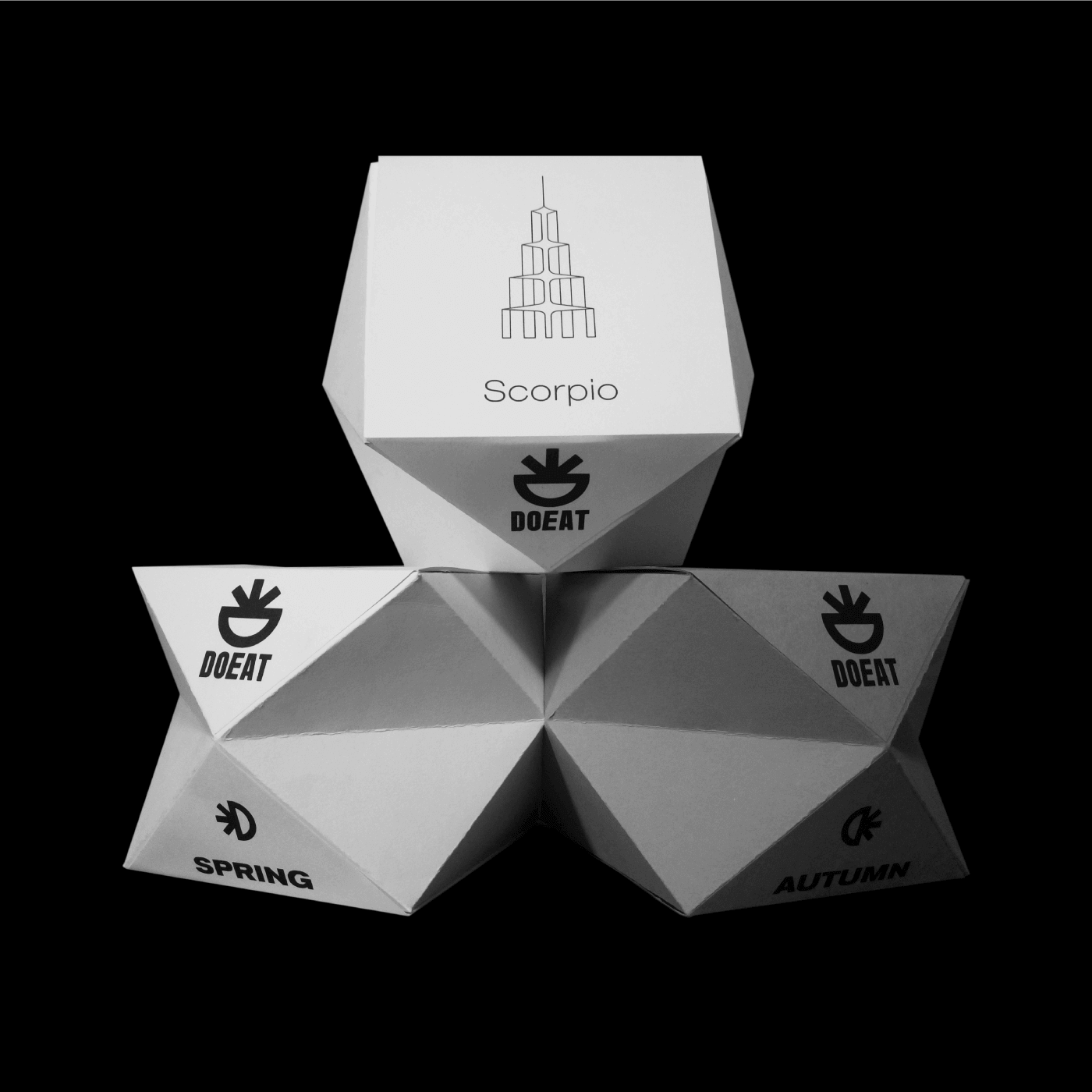
The packaging of the salads and the fruit salads is divided into two categories, so that the contents of each stand apart. The domes were polygonal vaulted houses, and the packages became polygonal too. The salad packages refer more to domes, while for the fruit salads I kept the polygonal form. The complexity of the shapes, the way the triangles connect, beyond their conceptual match with the concept of the Whole Earth Catalog, also offer a visually interesting and eye-catching object, which will matter on the shelf where it is displayed; the consumer will not be indifferent on seeing it, but will want to discover what is inside.
Finally, we must note here that the domes were made with polygons and unusual shapes in order to “escape” the established, boring, stereotyped and given square box that still houses most people around the world. Beyond the structure, though, the goal was to help them escape the square logic on which they had learned to live. How can anyone think differently and outside the system while staying in the structure the system dictates? Doeat, in turn, tries to give people a new form of logic and thinking. It wants to make them doers and not viewers, as we have written above. So, always in relation to its ideological direction, doeat had to follow a package shape outside the logic of the square.
As for the final packages, they meet the following specifications, so that they serve and represent the original goals of the Doeat company.
Continuing with the D.I.Y. and the back to land movement philosophy as the foundation of both design and communication, and combining it with the natural split between salad and fruit salad by content, their names were decided and given. The facts, to look at them in detail, were as follows:
They had to relate in some way to the movements mentioned above. The main source of inspiration was the Whole Earth Catalog. From here, then, we keep Earth, which means Γη, and the Earth is a planet. In the end we kept the idea of the planet.
The two categories had to be told apart, since this is also the logical thing, as salad is, at this stage, a main course, while fruit salad is by nature a starter or a dessert. From this we keep the split between main course and dessert.
Finally, for the naming to succeed, always by my own standards and personal approach, the names had to show their Greekness clearly, that is, the Greek origin of the fruit and vegetables. From here, we keep the word Greekness.
So, according to the ideas of planet, main course and dessert, and Greekness, the products were given their names. The salads took the names of planets, and the fruit salads the names of imaginary spaceships. The idea of the planet was covered this way. The Whole Earth Catalog played, as you understand, a decisive role in this. The split between main course and dessert was covered by the split between planets and spaceships, where the main course and the planets have the central role, while the dessert and the spaceships play the supporting role. Finally, Greekness is present in the names of both categories. The planets borrowed their names from the Greek twelve gods and from the Titans, while the spaceships chosen to give their names to the fruit salads have names that refer to ancient Greek history. Some of the names are of Latin origin, but the historical basis of all of them comes from ancient Greece and mythology. The names in detail:
The symbols of the salads and fruit salads had to be based, in shape, on two categories: planets and spaceships. And so it was. The planets were drawn as round shapes, while the spaceships as tall, narrow ones. All the drawings were found in the Whole Earth Catalog, which contains structural designs. They were developed, changed and redrawn.
We see them in order below, together with their names.
To promote the company, typographic posters were created that lead to its website address.
The posters carry typographic messages taken from the global environmental demonstrations organised by Greta Thunberg through the “Fridays for Future” movement.
The messages were found written on students’ placards, and from all of them the five most interesting were chosen to represent Doeat in its communication. Alongside each message, each poster uses one of the symbols of the four seasons, as well as the logo mark.
This was done to show the analogy and the link between the old movements for the protection of the environment and self-sufficiency, which inspired Doeat, and the modern version of these movements, which occupied society quite recently and reminded everyone of the need to protect the environment.
Reaching the end, it is important to reflect on the real substance and to look for the true purpose and goal of this, and of any other, undertaking that takes shape for commercial reasons. We live in a time of high competition, of fast and different speeds, a time when the need to survive grows ever stronger compared with the recent past.
The economic crisis, with all it implies, makes people flexible and adaptable, dynamic and innovative, with originality and standing apart from the usual conditions as their main concern, in production, in trade and in general in the ever-changing demands of life. The need for economic, mainly, but also social progress gives birth to ideas that either fail or achieve their goals to some degree.
The imaginary company DoEat is a result of these conditions; it is a true child of the times we live in. In 2020, uncertainty (not only about the future but about the immediate present) seems to sharpen imagination and entrepreneurship, and this is a general observation. More and more people step out of their comfort zone, since safety has now shrunk a great deal compared with the past.
In light of the above, I want to say that the Doeat project, through the ethics it projects outwards, that is, through the ideals and positions it is called to represent, tries first to win the attention and then the trust of the consumer, in order to achieve the only goal and purpose that any commercial undertaking has: financial gain.
Logo design. A logo that reads at a glance and that you won't want to replace in two years. When it helps, I draw custom lettering or a whole typeface, as I did for Nikol Tools.
Brand identity. The logo is the start. The identity is the colours, type and rules that make a business card, a paper bag and a post look like they came from the same shop.
Packaging. Labels, boxes and bags you notice on the shelf and can read easily, from bread and pastries to coffee and olive oil.
Website design. Websites that load fast, look right on a phone and show up on Google when someone searches for what you do. I plan the structure and copy with you, build the site from scratch and hand it over with an admin panel of your own.
Print and editorial. Menus, catalogues, posters, leaflets and business cards. I hand them over print-ready, so there are no surprises at the printer.
Looking for a logo, a brand identity, packaging, a website and print for your own business? Tell me about it and I will reply with a written quote, or see the packages with prices.